


Page 558 - Fair, Geyer, and Okun's Water and wastewater engineering : water supply and wastewater removal
P. 558
JWCL344_ch14_500-554.qxd  8/7/10  8:56 PM  Page 516


                    516  Chapter 14  Design of Sewer Systems                                              Sill #41


                                       Sill #569 hiram mills street  Sill #15  Sill #22  Sill #21  Sill #24  Sill #30  Sill #33  Sill #34  Sill #40


                       Hiram mills  street                           •1˝ Gas     Sill #27  Cinders  Tarvia  Loam  1˝ Gas
                                                                                                   Gravel fill


                                Tarvia  Cinders              Gravel fill                            10˝ v.c. 5 ˝ water
                                                                                                    drain
                                                        164.59´                                           9
                                                   Loam   •  5 ˝ water•  5 ˝ water•
                                 Gravel fill         1˝ Gas    8    8                 •  1˝ Gas  5 ˝ water  5.28%
                                                                                                 9
                                                       10˝ v.c. drain  3.36%             Nest of
                         4˝ Gas  10˝−12˝                                                 boulders    Underdrain
                                                 8 inch vit. clay pipe sewer
                              Tel. cond. 135.86´
                         10˝ C.I.  10˝ v.c.    and clay mixture  Underdrain  • 1˝ Gas              219.78´
                          water
                                                                            8 inch vitrified clay pipe sewer
                                 6˝ C.I. water                            Loam    5 ˝ water
                            Drains       Gravel                                     8
                        10˝ v.c.       1.80%                               Gravel
                          8 inch v.c. sewer                                       6˝ of pea gravel
                          12˝ v.c.
                         6˝ of pea gravel       1 	 43.5 Y.R.   1 	 48.5 Y.L.   1 	 77.6 Y.L.   1 	 94.5 Y.R.   2 	 21.5 Y.R.   2 	 25.6 Y.L.   2 	 45.6 Y.L.   2 	 69.5 Y.R.   2 	 79.8 Y.L.   2 	 84.8 Y.R.   2 	 93.0 Y.R.  −  − −   4 	 11.0 Y.R.   4 	 16.0 Y.L.   4 	 36.0 Y.R.   4 	 41.2 Y.L.   4 	 69.9 Y.L.   4 	 92.7 Y.R.   5 	 07.0 Y.L.   5 	 15.1 Y.R.
                       119.5  111.19  120.2  0 	 98.5 Y.R.  120.6  1 	 06.5 Y.L.  121.1  113.64  121.6  122.7  124.0  126.2  119.18  3 	 08.7 Y.L.  3 	 40.6 Y.R.  3 	 45.5 Y.L.  129.0  3 	 59.6 Y.R. −  3 	 73.6 Y.L. −  3 	 84.9 Y.R. −  131.9  134.6  137.3  138.3  130.80
                                  Base   elev.   105.00                                  Base elev. 115.00
                       0               1    1 	 35.86  2               3 	 00.48        4               5 	 20.23
                                               Lemuel      Shattuck    Street
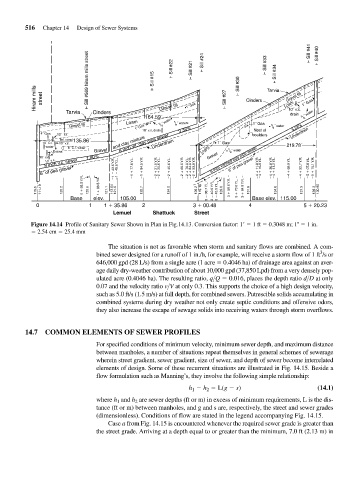
                      Figure 14.14 Profile of Sanitary Sewer Shown in Plan in Fig.14.13. Conversion factor: 1   1 ft   0.3048 m; 1   1 in.
                        2.54 cm   25.4 mm
                                             The situation is not as favorable when storm and sanitary flows are combined. A com-
                                                                                                             3
                                         bined sewer designed for a runoff of 1 in./h, for example, will receive a storm flow of 1 ft /s or
                                         646,000 gpd (28 L/s) from a single acre (1 acre   0.4046 ha) of drainage area against an aver-
                                         age daily dry-weather contribution of about 10,000 gpd (37,850 Lpd) from a very densely pop-
                                         ulated acre (0.4046 ha). The resulting ratio, q>Q   0.016, places the depth ratio d>D at only
                                          0.07 and the velocity ratio v>V at only 0.3. This supports the choice of a high design velocity,
                                          such as 5.0 ft/s (1.5 m/s) at full depth, for combined sewers. Putrescible solids accumulating in
                                          combined systems during dry weather not only create septic conditions and offensive odors,
                                          they also increase the escape of sewage solids into receiving waters through storm overflows.


                    14.7  COMMON ELEMENTS OF SEWER PROFILES

                                         For specified conditions of minimum velocity, minimum sewer depth, and maximum distance
                                         between manholes, a number of situations repeat themselves in general schemes of sewerage
                                         wherein street gradient, sewer gradient, size of sewer, and depth of sewer become interrelated
                                         elements of design. Some of these recurrent situations are illustrated in Fig. 14.15. Beside a
                                         flow formulation such as Manning’s, they involve the following simple relationship:
                                                                      h   h   L(g   s)                       (14.1)
                                                                       1
                                                                           2
                                          where h and h are sewer depths (ft or m) in excess of minimum requirements, L is the dis-
                                                     2
                                                1
                                         tance (ft or m) between manholes, and g and s are, respectively, the street and sewer grades
                                         (dimensionless). Conditions of flow are stated in the legend accompanying Fig. 14.15.
                                             Case a from Fig. 14.15 is encountered whenever the required sewer grade is greater than
                                         the street grade. Arriving at a depth equal to or greater than the minimum, 7.0 ft (2.13 m) in

