


Page 560 - Fair, Geyer, and Okun's Water and wastewater engineering : water supply and wastewater removal
P. 560
JWCL344_ch14_500-554.qxd  8/7/10  8:56 PM  Page 518


                    518  Chapter 14  Design of Sewer Systems
                                         this instance, the sewer becomes deeper and deeper until it is more economical to lift the
                                         sewage by placing a pumping station in the line. Specifically for Case a in Fig. 14.15, the
                                         sewer grade is held at minimum (0.33%), and h   h   L(g   s)   0.9   3(0.033   0.33)
                                                                              2
                                                                                  1
                                          1.8 ft or 0.55 m, the depth increasing by (1.8   0.9)   0.9 ft, or 0.27 m.
                                             Case b is unusual in that the required sewer grade is the same as the street grade.
                                          Therefore, the depth of the sewer remains unchanged.
                                             Case c introduces a street grade steep enough to provide the required capacity in an 8-in.
                                          (200-mm), rather than a 10-in. (250-mm), parallel conduit. Arriving at minimum depth, there
                                          is no possibility of utilizing the available fall in part or as a whole to recover minimum depth
                                          as in Cases d and e. The reduced pipe size becomes the sole profit from the steep street grade,
                                          provided usually that the upstream sewer is also no greater than 8 in. (200 mm).
                                             Case d aims at maximum reduction of excess depth by replacing a 10-in. (250-mm)
                                          sewer on minimum grade or, in accordance with Eq. 14.1, s   g   (h   h )>L. For h   0,
                                                                                                    2
                                                                                                1
                                                                                                             2
                                          s   1.00   (0.9   0.0)>3   0.70%, which is more than the required minimum of 0.33%.
                                          Hence the sewer can be brought back to minimum depth, or   7 ft.
                                             Case e is like Case d, but full reduction to minimum depth is not attainable, because s
                                          0.70   (1.9   0.0)>3   0.07%. This is less than the required minimum of 0.33%. Hence the
                                          minimum grade must be used, and h   1.9   3(0.70   0.33)   0.8 ft (0.244 m).
                                                                      2
                                             Case f illustrates how high velocities can be avoided by introducing drop manholes on
                                          steep slopes. Case f parallels Case d but provides a drop of 1.1 ft (0.335 m) to place the sewer
                                          on minimum grade and give it minimum velocity. Such action is normal only when grades are
                                          extraordinarily steep. Excessive drops and resulting excessive sewer depth can then be avoided
                                          by breaking the drops into two or more steps through insertion of intermediate drop manholes.
                                             Because the sewers flow nearly full, no attention needs to be paid to actual velocities
                                          and depths of flow in these illustrative cases. Consideration of actual depths and velocities
                                          of flow is generally restricted to the upper reaches of sewers flowing less than half full.
                                          There, the designer may have to forgo self-cleaning grades for lateral sewers. Otherwise,
                                          they might reach the main sewer at an elevation below that of the main itself, and the main
                                          would have to be lowered to intercept them. Normally this would be expensive.
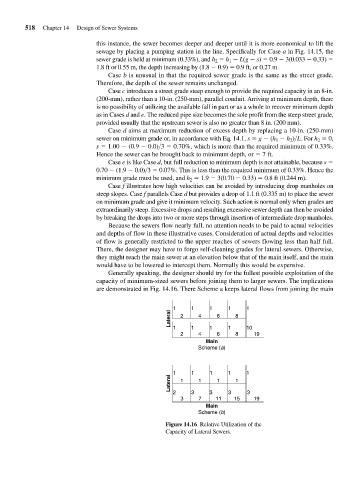
                                             Generally speaking, the designer should try for the fullest possible exploitation of the
                                          capacity of minimum-sized sewers before joining them to larger sewers. The implications
                                          are demonstrated in Fig. 14.16. There Scheme a keeps lateral flows from joining the main


                                                                 1    1     1     1    1
                                                                Lateral  2  4  6    8
                                                                 1
                                                                   2  1  4  1  6  1  8  10  19
                                                                           Main
                                                                        Scheme (a)


                                                                 1    1     1     1    1
                                                                Lateral  1  1  1    1

                                                                 2
                                                                   3  3  7  3  11  3  15  3  19
                                                                           Main
                                                                        Scheme (b)

                                                               Figure 14.16 Relative Utilization of the
                                                               Capacity of Lateral Sewers.

