


Page 295 - Fiber Fracture
P. 295
FRACTURE OF HIGHLY  ORIENTED, CHAIN-EXTENDED POLYMER FIBRES          217


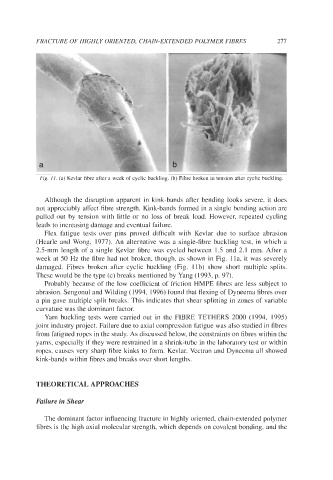
            Fig.  11. (a) Kevlar fibre after a week of cyclic buckling. (b) Fibre broken in tension after cyclic buckling.


              Although the disruption  apparent in kink-bands  after bending  looks severe, it does
           not appreciably affect fibre strength. Kink-bands formed in a single bending action are
           pulled out by  tension with little or no  loss of  break  load.  However, repeated  cycling
           leads to increasing damage and eventual failure.
              Flex  fatigue  tests  over  pins  proved  difficult  with  Kevlar  due  to  surface  abrasion
           (Hearle and Wong,  1977). An  alternative was a  single-fibre buckling test, in  which  a
           2.5-mm length of  a single Kevlar fibre was cycled between  1.5 and  2.1  mm. After  a
           week at 50 Hz the fibre had not broken, though, as shown in Fig.  lla, it was severely
           damaged.  Fibres  broken  after  cyclic  buckling  (Fig.  1 lb)  show  short  multiple  splits.
           These would be the type (c) breaks mentioned by Yang (1993, p. 97).
              Probably because of  the low coefficient of friction HMPE fibres are less subject to
           abrasion. Sengonul and Wilding (1994, 1996) found that flexing of Dyneema fibres over
           a pin gave multiple split breaks. This indicates that shear splitting in zones of  variable
           curvature was the dominant factor.
              Yarn  buckling  tests  were carried  out  in the FIBRE  TETHERS  2000  (1994,  1995)
           joint industry project. Failure due to axial compression fatigue was also studied in fibres
           from fatigued ropes in the study. As discussed below, the constraints on fibres within the
           yarns, especially if they were restrained in a shrink-tube in the laboratory test or within
           ropes, causes very sharp fibre kinks to form. Kevlar, Vectran and Dyneema all showed
           kink-bands within fibres and breaks over short lengths.


           THEORETICAL APPROACHES

           Failure in Shear

              The dominant factor influencing fracture in highly oriented, chain-extended polymer
           fibres is the high axial molecular strength, which depends on covalent bonding, and the

