


Page 484 - Flexible Robotics in Medicine
P. 484
478 Chapter 21

            that is inserted in the endoscopic manipulator working channel, a distal controllable
            compression spring connected to the said tension spring, and a biopsy forceps. The insertion
            portion comprises of the three latter components. The proximal control uses a ball and
            socket mechanism to transmit omnidirectional control to the distal spring. This control
            method is intuitive and easy to master. The insertion portion is of smaller diameter
            (3 5 mm) to prevent irritation when inserted into the patient’s open channel. The
            compression spring is connected to four driven metal cables at the distal end. These four
            cables transmit motion from the proximal control to the distal actuation spring (Fig. 21.1).
            The cables used in the design are metal cables since it can exert both push and pull force,
            secure and nonelastic so that it can transmit precise movement. Moreover, compression
            spring exerts counter-moment and hence stabilizes the system. The compression spring
            portion can also detach from the distal end to reach the target lesion. The forceps are like a
            conventional biopsy forceps with hollow cups to hold the lesion and is controlled by a
            metal cable capable of push and pull. The whole system, especially the insertion portion,
            has minimal and straightforward components, which is easy to manufacture and scale down
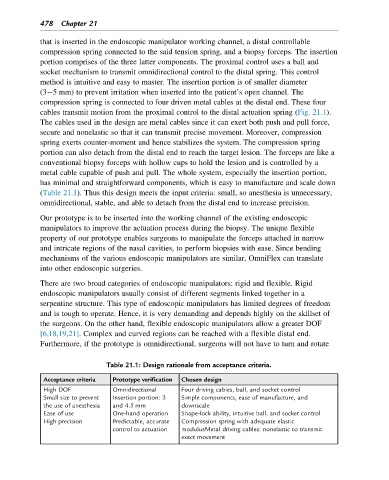
            (Table 21.1). Thus this design meets the input criteria: small, so anesthesia is unnecessary,
            omnidirectional, stable, and able to detach from the distal end to increase precision.
            Our prototype is to be inserted into the working channel of the existing endoscopic
            manipulators to improve the actuation process during the biopsy. The unique flexible
            property of our prototype enables surgeons to manipulate the forceps attached in narrow
            and intricate regions of the nasal cavities, to perform biopsies with ease. Since bending
            mechanisms of the various endoscopic manipulators are similar, OmniFlex can translate
            into other endoscopic surgeries.
            There are two broad categories of endoscopic manipulators: rigid and flexible. Rigid
            endoscopic manipulators usually consist of different segments linked together in a
            serpentine structure. This type of endoscopic manipulators has limited degrees of freedom
            and is tough to operate. Hence, it is very demanding and depends highly on the skillset of
            the surgeons. On the other hand, flexible endoscopic manipulators allow a greater DOF
            [6,18,19,21]. Complex and curved regions can be reached with a flexible distal end.
            Furthermore, if the prototype is omnidirectional, surgeons will not have to turn and rotate


                               Table 21.1: Design rationale from acceptance criteria.
             Acceptance criteria  Prototype verification  Chosen design
             High DOF           Omnidirectional    Four driving cables, ball, and socket control
             Small size to prevent  Insertion portion: 3  Simple components, ease of manufacture, and
             the use of anesthesia  and 4.5 mm     downscale
             Ease of use        One-hand operation  Shape-lock ability, intuitive ball, and socket control
             High precision     Predictable, accurate  Compression spring with adequate elastic
                                control to actuation  modulusMetal driving cables: nonelastic to transmit
                                                   exact movement

