


Page 486 - Flexible Robotics in Medicine
P. 486
480 Chapter 21


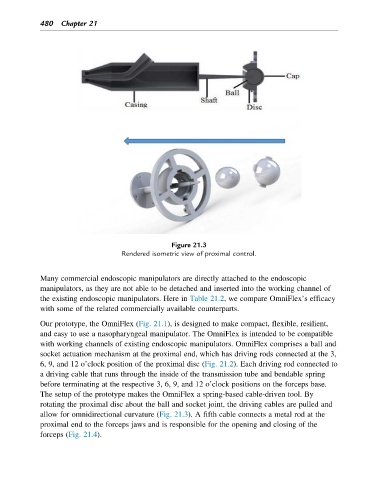
                                                 Figure 21.3
                                   Rendered isometric view of proximal control.


            Many commercial endoscopic manipulators are directly attached to the endoscopic
            manipulators, as they are not able to be detached and inserted into the working channel of
            the existing endoscopic manipulators. Here in Table 21.2, we compare OmniFlex’s efficacy
            with some of the related commercially available counterparts.

            Our prototype, the OmniFlex (Fig. 21.1), is designed to make compact, flexible, resilient,
            and easy to use a nasopharyngeal manipulator. The OmniFlex is intended to be compatible
            with working channels of existing endoscopic manipulators. OmniFlex comprises a ball and
            socket actuation mechanism at the proximal end, which has driving rods connected at the 3,
            6, 9, and 12 o’clock position of the proximal disc (Fig. 21.2). Each driving rod connected to
            a driving cable that runs through the inside of the transmission tube and bendable spring
            before terminating at the respective 3, 6, 9, and 12 o’clock positions on the forceps base.
            The setup of the prototype makes the OmniFlex a spring-based cable-driven tool. By
            rotating the proximal disc about the ball and socket joint, the driving cables are pulled and
            allow for omnidirectional curvature (Fig. 21.3). A fifth cable connects a metal rod at the
            proximal end to the forceps jaws and is responsible for the opening and closing of the
            forceps (Fig. 21.4).

