


Page 487 - Flexible Robotics in Medicine
P. 487
OmniFlex: omnidirectional flexible hand-held endoscopic manipulator with spheroidal joint 481


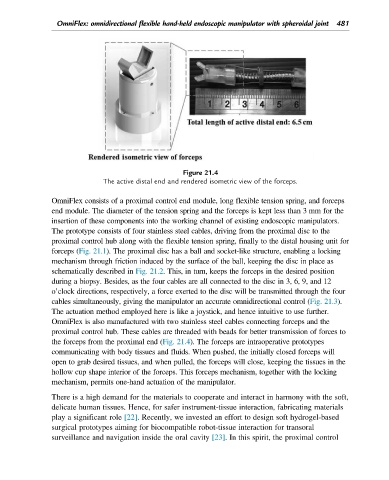
                                                    Figure 21.4
                              The active distal end and rendered isometric view of the forceps.

               OmniFlex consists of a proximal control end module, long flexible tension spring, and forceps
               end module. The diameter of the tension spring and the forceps is kept less than 3 mm for the
               insertion of these components into the working channel of existing endoscopic manipulators.
               The prototype consists of four stainless steel cables, driving from the proximal disc to the
               proximal control hub along with the flexible tension spring, finally to the distal housing unit for
               forceps (Fig. 21.1). The proximal disc has a ball and socket-like structure, enabling a locking
               mechanism through friction induced by the surface of the ball, keeping the disc in place as
               schematically described in Fig. 21.2. This, in turn, keeps the forceps in the desired position
               during a biopsy. Besides, as the four cables are all connected to the disc in 3, 6, 9, and 12
               o’clock directions, respectively, a force exerted to the disc will be transmitted through the four
               cables simultaneously, giving the manipulator an accurate omnidirectional control (Fig. 21.3).
               The actuation method employed here is like a joystick, and hence intuitive to use further.
               OmniFlex is also manufactured with two stainless steel cables connecting forceps and the
               proximal control hub. These cables are threaded with beads for better transmission of forces to
               the forceps from the proximal end (Fig. 21.4). The forceps are intraoperative prototypes
               communicating with body tissues and fluids. When pushed, the initially closed forceps will
               open to grab desired tissues, and when pulled, the forceps will close, keeping the tissues in the
               hollow cup shape interior of the forceps. This forceps mechanism, together with the locking
               mechanism, permits one-hand actuation of the manipulator.
               There is a high demand for the materials to cooperate and interact in harmony with the soft,
               delicate human tissues. Hence, for safer instrument-tissue interaction, fabricating materials
               play a significant role [22]. Recently, we invested an effort to design soft hydrogel-based
               surgical prototypes aiming for biocompatible robot-tissue interaction for transoral
               surveillance and navigation inside the oral cavity [23]. In this spirit, the proximal control

