


Page 147 - Fluid Mechanics and Thermodynamics of Turbomachinery
P. 147
128 Fluid Mechanics, Thermodynamics of Turbomachinery
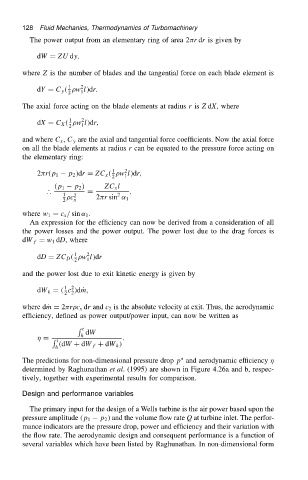
                            The power output from an elementary ring of area 2 r dr is given by

                              dW D ZU dy,

                          where Z is the number of blades and the tangential force on each blade element is
                                          2
                                      1
                              dY D C y .  w l/dr.
                                      2   1
                          The axial force acting on the blade elements at radius r is Z dX, where
                                          2
                                       1
                              dX D C X .  w l/dr,
                                       2  1
                          and where C x , C y are the axial and tangential force coefficients. Now the axial force
                          on all the blade elements at radius r can be equated to the pressure force acting on
                          the elementary ring:

                                                      2
                                                   1
                                      p 2 /dr D ZC x .  w l/dr,
                              2 r.p 1                 1
                                                   2
                                 ∴  .p 1  p 2 /  D  ZC x l  ,
                                     1  c 2         2
                                     2  x     2 r sin ˛ 1
                          where w 1 D c x / sin ˛ 1 .
                            An expression for the efficiency can now be derived from a consideration of all
                          the power losses and the power output. The power lost due to the drag forces is
                          dW f D w 1 dD, where

                                        1
                                            2
                              dD D ZC D .  w l/dr
                                        2   1
                          and the power lost due to exit kinetic energy is given by
                                     1 2
                              dW k D . c /d Pm,
                                     2 2
                          where d Pm D 2 r c x dr and c 2 is the absolute velocity at exit. Thus, the aerodynamic
                          efficiency, defined as power output/power input, can now be written as
                                          t
                                         R
                                          h  dW
                                D R                  .
                                   t
                                   h .dW C dW f C dW k /
                                                                     Ł
                          The predictions for non-dimensional pressure drop p and aerodynamic efficiency
                          determined by Raghunathan et al. (1995) are shown in Figure 4.26a and b, respec-
                          tively, together with experimental results for comparison.
                          Design and performance variables

                            The primary input for the design of a Wells turbine is the air power based upon the
                                               p 2 / and the volume flow rate Q at turbine inlet. The perfor-
                          pressure amplitude .p 1
                          mance indicators are the pressure drop, power and efficiency and their variation with
                          the flow rate. The aerodynamic design and consequent performance is a function of
                          several variables which have been listed by Raghunathan. In non-dimensional form

