


Page 144 - Fluid Mechanics and Thermodynamics of Turbomachinery
P. 144
Axial-flow Turbines: Two-dimensional Theory  125


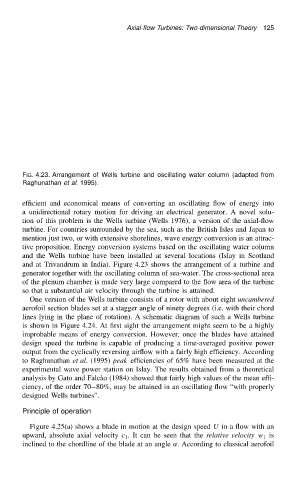
                          FIG. 4.23. Arrangement of Wells turbine and oscillating water column (adapted from
                          Raghunathan et al. 1995).

                          efficient and economical means of converting an oscillating flow of energy into
                          a unidirectional rotary motion for driving an electrical generator. A novel solu-
                          tion of this problem is the Wells turbine (Wells 1976), a version of the axial-flow
                          turbine. For countries surrounded by the sea, such as the British Isles and Japan to
                          mention just two, or with extensive shorelines, wave energy conversion is an attrac-
                          tive proposition. Energy conversion systems based on the oscillating water column
                          and the Wells turbine have been installed at several locations (Islay in Scotland
                          and at Trivandrum in India). Figure 4.23 shows the arrangement of a turbine and
                          generator together with the oscillating column of sea-water. The cross-sectional area
                          of the plenum chamber is made very large compared to the flow area of the turbine
                          so that a substantial air velocity through the turbine is attained.
                            One version of the Wells turbine consists of a rotor with about eight uncambered
                          aerofoil section blades set at a stagger angle of ninety degrees (i.e. with their chord
                          lines lying in the plane of rotation). A schematic diagram of such a Wells turbine
                          is shown in Figure 4.24. At first sight the arrangement might seem to be a highly
                          improbable means of energy conversion. However, once the blades have attained
                          design speed the turbine is capable of producing a time-averaged positive power
                          output from the cyclically reversing airflow with a fairly high efficiency. According
                          to Raghunathan et al. (1995) peak efficiencies of 65% have been measured at the
                          experimental wave power station on Islay. The results obtained from a theoretical
                          analysis by Gato and Falc` ao (1984) showed that fairly high values of the mean effi-
                          ciency, of the order 70 80%, may be attained in an oscillating flow “with properly
                          designed Wells turbines”.

                          Principle of operation
                            Figure 4.25(a) shows a blade in motion at the design speed U in a flow with an
                          upward, absolute axial velocity c 1 . It can be seen that the relative velocity w 1 is
                          inclined to the chordline of the blade at an angle ˛. According to classical aerofoil

