


Page 140 - Fluid Mechanics and Thermodynamics of Turbomachinery
P. 140
Axial-flow Turbines: Two-dimensional Theory  121


                          FIG. 4.19. Cooled HP turbine rotor blade showing the cooling passages (courtesy of
                                                      Rolls-Royce plc).


                              90   Conway, Spey

                                                                             Low hub/tip ratio
                           Efficiency, Percent  80  ADOUR    RB 211


                                        High hub/tip ratio

                                                                         Engine Test
                                                                           Facility Results
                                          Internal convection   Internal convection  Transpiration
                                              cooling            and film cooling     cooling
                                 Uncooled

                              70
                                     1300            1500            1700            1900
                                                         Turbine entry temp., K
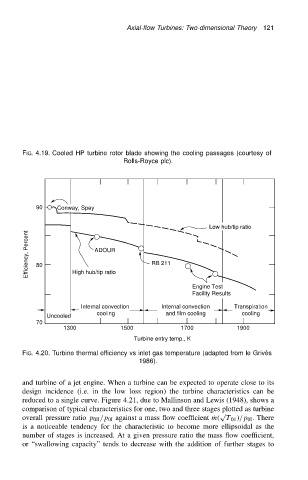
                          FIG. 4.20. Turbine thermal efficiency vs inlet gas temperature (adapted from le Griv` es
                                                          1986).


                          and turbine of a jet engine. When a turbine can be expected to operate close to its
                          design incidence (i.e. in the low loss region) the turbine characteristics can be
                          reduced to a single curve. Figure 4.21, due to Mallinson and Lewis (1948), shows a
                          comparison of typical characteristics for one, two and three stages plotted as turbine
                                                                                p
                          overall pressure ratio p 0II /p 0I against a mass flow coefficient Pm. T 01 //p 0I . There
                          is a noticeable tendency for the characteristic to become more ellipsoidal as the
                          number of stages is increased. At a given pressure ratio the mass flow coefficient,
                          or “swallowing capacity” tends to decrease with the addition of further stages to

