


Page 143 - Fluid Mechanics and Thermodynamics of Turbomachinery
P. 143
124 Fluid Mechanics, Thermodynamics of Turbomachinery
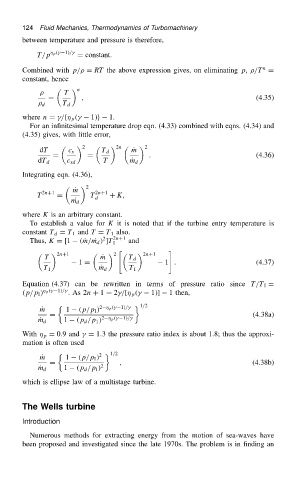
                          between temperature and pressure is therefore,
                                    p .
 1//
                              T/p        D constant.
                                                                                            n
                          Combined with p/  D RT the above expression gives, on eliminating p,  /T D
                          constant, hence
                                         n
                                     T
                                 D        ,                                               (4.35)
                                d    T d
                          where n D
/f  p .
  1/g 1.
                            For an infinitesimal temperature drop eqn. (4.33) combined with eqns. (4.34) and
                          (4.35) gives, with little error,

                                                    2n
                                           2                2
                               dT      c x      T d     P m
                                  D         D                .                            (4.36)
                              dT d    c xd      T       P m d
                          Integrating eqn. (4.36),
                                            2
                                        P m   2nC1
                               2nC1
                              T    D         T    C K,
                                              d
                                        P m d
                          where K is an arbitrary constant.
                            To establish a value for K it is noted that if the turbine entry temperature is
                          constant T d D T 1 and T D T 1 also.
                                                2
                            Thus, K D [1  . Pm/ P d / ]T 2nC1  and
                                             m
                                                   I
                                                    "             #
                                    2nC1           2        2nC1
                                T               P m    T d
                                         1 D                     1 .                      (4.37)
                                T I            P m d   T I
                          Equation (4.37) can be rewritten in terms of pressure ratio since T/T I D
                          .p/p I /   p .
 1//
 .As2n C 1 D 2
/[  p .
  1/]  1 then,
                                               2   p .
 1//
    1/2
                               P m    1  .p/p I /
                                 D              2   p .
 1//
                            (4.38a)
                               P m d  1  .p d /p 1 /
                          With   p D 0.9 and
 D 1.3 the pressure ratio index is about 1.8; thus the approxi-
                          mation is often used
                                               2    1/2
                               P m    1  .p/p I /
                                 D             2     ,                                   (4.38b)
                               P m d  1  .p d /p I /
                          which is ellipse law of a multistage turbine.


                          The Wells turbine

                          Introduction
                            Numerous methods for extracting energy from the motion of sea-waves have
                          been proposed and investigated since the late 1970s. The problem is in finding an

