


Page 138 - Fluid Mechanics and Thermodynamics of Turbomachinery
P. 138
Axial-flow Turbines: Two-dimensional Theory  119
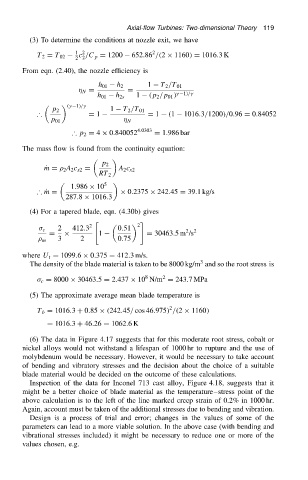
                            (3) To determine the conditions at nozzle exit, we have
                                        1 2                   2
                              T 2 D T 02  c /C p D 1200  652.86 /.2 ð 1160/ D 1016.3K
                                        2 2
                          From eqn. (2.40), the nozzle efficiency is

                                                            1
                                               h 01  h 2        T 2 /T 01
                                           N D         D
 1//
                                               h 01  h 2s  1  .p 2 /p 01 /
                                      .
 1//

                              ∴   p 2       D 1   1   T 2 /T 01  D 1  .1  1016.3/1200//0.96 D 0.84052
                                  p 01                  N
                                                          4.0303
                                        ∴ p 2 D 4 ð 0.840052  D 1.986 bar
                          The mass flow is found from the continuity equation:

                                                p 2
                                P m D   2 A 2 c x2 D  A 2 c x2
                                               RT 2
                                                5
                                       1.986 ð 10
                              ∴ Pm D                 ð 0.2375 ð 242.45 D 39.1 kg/s
                                      287.8 ð 1016.3
                            (4) For a tapered blade, eqn. (4.30b) gives
                                              "            #
                                    2   412.3 2     0.51  2
                                c                                      2  2
                                 D   ð         1            D 30463.5m /s
                                m   3     2         0.75
                          where U t D 1099.6 ð 0.375 D 412.3 m/s.
                                                                           3
                            The density of the blade material is taken to be 8000 kg/m and so the root stress is
                                                            8
                                                                2
                                c D 8000 ð 30463.5 D 2.437 ð 10 N/m D 243.7 MPa
                            (5) The approximate average mean blade temperature is
                                                                  2
                              T b D 1016.3 C 0.85 ð .242.45/ cos 46.975/ /.2 ð 1160/
                                 D 1016.3 C 46.26 D 1062.6K

                            (6) The data in Figure 4.17 suggests that for this moderate root stress, cobalt or
                          nickel alloys would not withstand a lifespan of 1000 hr to rupture and the use of
                          molybdenum would be necessary. However, it would be necessary to take account
                          of bending and vibratory stresses and the decision about the choice of a suitable
                          blade material would be decided on the outcome of these calculations.
                            Inspection of the data for Inconel 713 cast alloy, Figure 4.18, suggests that it
                          might be a better choice of blade material as the temperature stress point of the
                          above calculation is to the left of the line marked creep strain of 0.2% in 1000 hr.
                          Again, account must be taken of the additional stresses due to bending and vibration.
                            Design is a process of trial and error; changes in the values of some of the
                          parameters can lead to a more viable solution. In the above case (with bending and
                          vibrational stresses included) it might be necessary to reduce one or more of the
                          values chosen, e.g.

