


Page 135 - Fluid Mechanics and Thermodynamics of Turbomachinery
P. 135
116 Fluid Mechanics, Thermodynamics of Turbomachinery
                          For blades with a constant cross-sectional area, we get
                                                   "         #
                                      Z          2           2
                                        r t
                                c    2          U t      r h
                                 D       r dr D    1          .                         (4.30a)
                                m               2        r t
                                       r h
                          A rotor blade is usually tapered both in chord and in thickness from root to tip
                          such that the area ratio A t /A h is between 1/3 and 1/4. For such a blade taper it is
                          often assumed that the blade stress is reduced to 2/3 of the value obtained for an
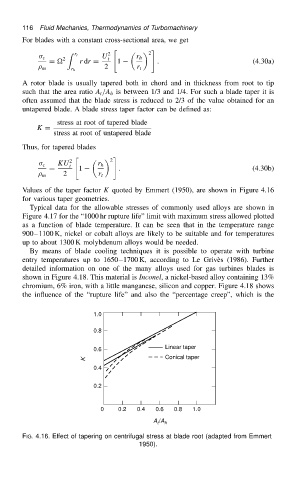
                          untapered blade. A blade stress taper factor can be defined as:
                                   stress at root of tapered blade
                              K D
                                  stress at root of untapered blade
                          Thus, for tapered blades

                                        "          2 #
                                    KU 2
                                c      t       r h
                                 D       1          .                                    (4.30b)
                                m    2         r t
                          Values of the taper factor K quoted by Emmert (1950), are shown in Figure 4.16
                          for various taper geometries.
                            Typical data for the allowable stresses of commonly used alloys are shown in
                          Figure 4.17 for the “1000 hr rupture life” limit with maximum stress allowed plotted
                          as a function of blade temperature. It can be seen that in the temperature range
                          900 1100 K, nickel or cobalt alloys are likely to be suitable and for temperatures
                          up to about 1300 K molybdenum alloys would be needed.
                            By means of blade cooling techniques it is possible to operate with turbine
                          entry temperatures up to 1650 1700 K, according to Le Griv` es (1986). Further
                          detailed information on one of the many alloys used for gas turbines blades is
                          shown in Figure 4.18. This material is Inconel, a nickel-based alloy containing 13%
                          chromium, 6% iron, with a little manganese, silicon and copper. Figure 4.18 shows
                          the influence of the “rupture life” and also the “percentage creep”, which is the

                                             1.0

                                             0.8

                                                                 Linear taper
                                             0.6
                                           K                     Conical taper
                                             0.4


                                             0.2


                                               0    0.2  0.4   0.6  0.8  1.0
                                                              A /A h
                                                               t
                          FIG. 4.16. Effect of tapering on centrifugal stress at blade root (adapted from Emmert
                                                          1950).

