


Page 131 - Fluid Mechanics and Thermodynamics of Turbomachinery
P. 131
112 Fluid Mechanics, Thermodynamics of Turbomachinery
Maximum total-to-static efficiency of a reversible
turbine stage
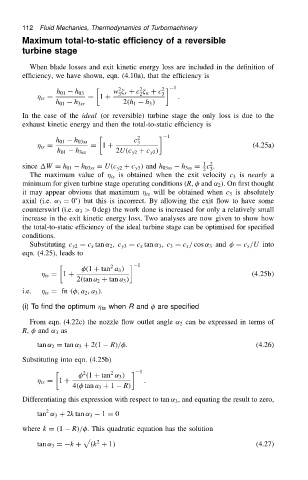
When blade losses and exit kinetic energy loss are included in the definition of
efficiency, we have shown, eqn. (4.10a), that the efficiency is
2 2 2 1
h 01 h 03 w r C c n C c 3
2
3
ts D D 1 C .
h 01 h 3ss 2.h 1 h 3 /
In the case of the ideal (or reversible) turbine stage the only loss is due to the
exhaust kinetic energy and then the total-to-static efficiency is
2 1
h 01 h 03ss c 3
ts D D 1 C (4.25a)
h 01 h 3ss 2U.c y2 C c y3 /
1 2
h 3ss D c .
since W D h 01 h 03ss D U.c y2 C c y3 / and h 03ss
2 3
The maximum value of ts is obtained when the exit velocity c 3 is nearly a
minimum for given turbine stage operating conditions (R, and ˛ 2 ). On first thought
it may appear obvious that maximum ts will be obtained when c 3 is absolutely
axial (i.e. ˛ 3 D 0 ° ) but this is incorrect. By allowing the exit flow to have some
counterswirl (i.e. ˛ 3 > 0 deg) the work done is increased for only a relatively small
increase in the exit kinetic energy loss. Two analyses are now given to show how
the total-to-static efficiency of the ideal turbine stage can be optimised for specified
conditions.
Substituting c y2 D c x tan ˛ 2 , c y3 D c x tan ˛ 3 , c 3 D c x / cos ˛ 3 and D c x /U into
eqn. (4.25), leads to
2 1
.1 C tan a 3 /
ts D 1 C .4.25b/
2.tan a 2 C tan a 3 /
i.e. ts D fn . , a 2 ,a 3 /.
(i) To find the optimum ts when R and are specified
From eqn. (4.22c) the nozzle flow outlet angle ˛ 2 can be expressed in terms of
R, and ˛ 3 as
tan ˛ 2 D tan ˛ 3 C 2.1 R// . (4.26)
Substituting into eqn. (4.25b)
2 2 1
.1 C tan ˛ 3 /
ts D 1 C .
4. tan a 3 C 1 R/
Differentiating this expression with respect to tan ˛ 3 , and equating the result to zero,
2
tan ˛ 3 C 2k tan ˛ 3 1 D 0
where k D .1 R// . This quadratic equation has the solution
p 2
tan ˛ 3 Dk C .k C 1/ (4.27)

