


Page 126 - Fluid Mechanics and Thermodynamics of Turbomachinery
P. 126
Axial-flow Turbines: Two-dimensional Theory 107
Therefore
1 0.0712 ð 1.16 C 0.89 ð 0.0666 ð 1.382 C 0.16
D 1 C
ts 2 ð 1.104
D 1 C 0.1468.
∴ ts D 0.872.
Choice of reaction and effect on efficiency
In Figure 4.4 the total-to-total and total-to-static efficiencies are shown plotted
2
against c y2 /U for several values of stage loading factor W/U . These curves
can now easily be replotted against the degree of reaction R instead of c y2 /U.
Equation (4.22c) can be rewritten as R D 1 C .c y3 c y2 //.2U/ and c y3 eliminated
using eqn. (4.16) to give
W c y2
R D 1 C . (4.24)
2U 2 U
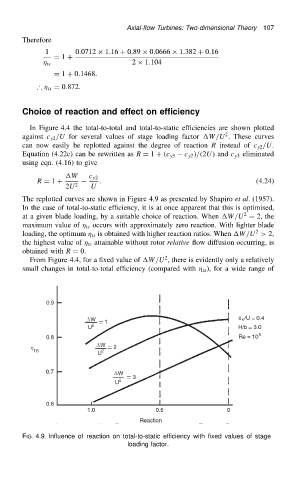
The replotted curves are shown in Figure 4.9 as presented by Shapiro et al. (1957).
In the case of total-to-static efficiency, it is at once apparent that this is optimised,
2
at a given blade loading, by a suitable choice of reaction. When W/U D 2, the
maximum value of ts occurs with approximately zero reaction. With lighter blade
2
loading, the optimum ts is obtained with higher reaction ratios. When W/U > 2,
the highest value of ts attainable without rotor relative flow diffusion occurring, is
obtained with R D 0.
2
From Figure 4.4, for a fixed value of W/U , there is evidently only a relatively
small changes in total-to-total efficiency (compared with ts ), for a wide range of
FIG. 4.9. Influence of reaction on total-to-static efficiency with fixed values of stage
loading factor.

