


Page 127 - Fluid Mechanics and Thermodynamics of Turbomachinery
P. 127
108 Fluid Mechanics, Thermodynamics of Turbomachinery
possible designs. Thus tt is not greatly affected by the choice of reaction. However,
the maximum value of tt decreases as the stage loading factor increases. To obtain
high total-to-total efficiency, it is therefore necessary to use the highest possible
2
value of blade speed consistent with blade stress limitations (i.e. to reduce W/U ).
Design point efficiency of a turbine stage
The performance of a turbine stage in terms of its efficiency is calculated for
several types of design, i.e. 50 per cent reaction, zero reaction and zero exit flow
angle, using the loss correlation method of Soderberg described earlier. These are
most usefully presented in the form of carpet plots of stage loading coefficient, ,
and flow coefficient, .
(1) Total-to-total efficiency of 50 per cent reaction stage
In a multistage turbine the total-to-total efficiency is the relevant performance
criterion, the kinetic energy at stage exit being recovered in the next stage. After
the last stage of a multistage turbine, or a single-stage turbine, the kinetic energy in
the exit flow would be recovered in a diffuser or used for another purpose (e.g. as
a contribution to the propulsive thrust).
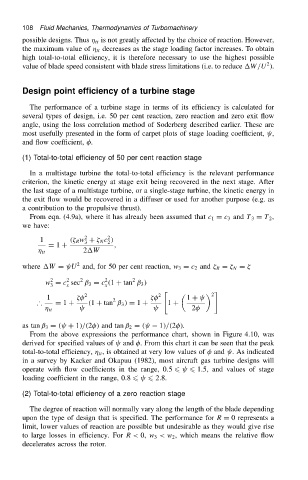
From eqn. (4.9a), where it has already been assumed that c 1 D c 3 and T 3 D T 2 ,
we have:
2
2
1 . R w C N c /
2
3
D 1 C ,
tt 2W
2
where W D U and, for 50 per cent reaction, w 3 D c 2 and R D N D
2
2
2
2
2
w D c sec ˇ 3 D c .1 C tan ˇ 3 /
3 x x
" 2 #
1 2 2 1 C
∴ D 1 C .1 C tan ˇ 3 / D 1 C 1 C
2
tt 2
as tan ˇ 3 D . C 1//.2 / and tan ˇ 2 D . 1//.2 /.
From the above expressions the performance chart, shown in Figure 4.10, was
derived for specified values of and . From this chart it can be seen that the peak
total-to-total efficiency, tt , is obtained at very low values of and . As indicated
in a survey by Kacker and Okapuu (1982), most aircraft gas turbine designs will
operate with flow coefficients in the range, 0.5 6 6 1.5, and values of stage
loading coefficient in the range, 0.8 6 6 2.8.
(2) Total-to-total efficiency of a zero reaction stage
The degree of reaction will normally vary along the length of the blade depending
upon the type of design that is specified. The performance for R D 0 represents a
limit, lower values of reaction are possible but undesirable as they would give rise
to large losses in efficiency. For R< 0, w 3 <w 2 , which means the relative flow
decelerates across the rotor.

