


Page 133 - Fluid Mechanics and Thermodynamics of Turbomachinery
P. 133
114 Fluid Mechanics, Thermodynamics of Turbomachinery


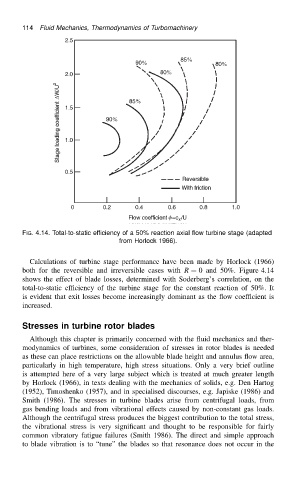
                          FIG. 4.14. Total-to-static efficiency of a 50% reaction axial flow turbine stage (adapted
                                                     from Horlock 1966).

                            Calculations of turbine stage performance have been made by Horlock (1966)
                          both for the reversible and irreversible cases with R D 0 and 50%. Figure 4.14
                          shows the effect of blade losses, determined with Soderberg’s correlation, on the
                          total-to-static efficiency of the turbine stage for the constant reaction of 50%. It
                          is evident that exit losses become increasingly dominant as the flow coefficient is
                          increased.

                          Stresses in turbine rotor blades

                            Although this chapter is primarily concerned with the fluid mechanics and ther-
                          modynamics of turbines, some consideration of stresses in rotor blades is needed
                          as these can place restrictions on the allowable blade height and annulus flow area,
                          particularly in high temperature, high stress situations. Only a very brief outline
                          is attempted here of a very large subject which is treated at much greater length
                          by Horlock (1966), in texts dealing with the mechanics of solids, e.g. Den Hartog
                          (1952), Timoshenko (1957), and in specialised discourses, e.g. Japiske (1986) and
                          Smith (1986). The stresses in turbine blades arise from centrifugal loads, from
                          gas bending loads and from vibrational effects caused by non-constant gas loads.
                          Although the centrifugal stress produces the biggest contribution to the total stress,
                          the vibrational stress is very significant and thought to be responsible for fairly
                          common vibratory fatigue failures (Smith 1986). The direct and simple approach
                          to blade vibration is to “tune” the blades so that resonance does not occur in the

