


Page 145 - Fluid Mechanics and Thermodynamics of Turbomachinery
P. 145
126 Fluid Mechanics, Thermodynamics of Turbomachinery
                                                          Electrical
                                                          generator

                                                          Turbo generator
                                                              shaft
                                  Oscillating
                                    air flow


                                                                      Tube
                                                Wells   turbine
                                                  (rotor hub)

                                        Uni-
                                             directional              Uncambered aerofoils
                                           rotation                   at 90 deg stagger angle
                                                                      (i.e. chord lines lie in
                                                                      plane of rotation)

                                   Oscillating
                                    air flow
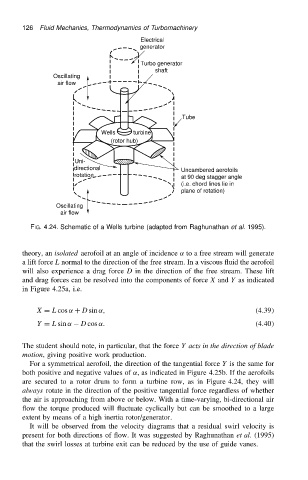
                            FIG. 4.24. Schematic of a Wells turbine (adapted from Raghunathan et al. 1995).


                          theory, an isolated aerofoil at an angle of incidence ˛ to a free stream will generate
                          a lift force L normal to the direction of the free stream. In a viscous fluid the aerofoil
                          will also experience a drag force D in the direction of the free stream. These lift
                          and drag forces can be resolved into the components of force X and Y as indicated
                          in Figure 4.25a, i.e.


                              X D L cos ˛ C D sin ˛,                                      .4.39/
                              Y D L sin ˛  D cos ˛.                                       .4.40/


                          The student should note, in particular, that the force Y acts in the direction of blade
                          motion, giving positive work production.
                            For a symmetrical aerofoil, the direction of the tangential force Y is the same for
                          both positive and negative values of ˛, as indicated in Figure 4.25b. If the aerofoils
                          are secured to a rotor drum to form a turbine row, as in Figure 4.24, they will
                          always rotate in the direction of the positive tangential force regardless of whether
                          the air is approaching from above or below. With a time-varying, bi-directional air
                          flow the torque produced will fluctuate cyclically but can be smoothed to a large
                          extent by means of a high inertia rotor/generator.
                            It will be observed from the velocity diagrams that a residual swirl velocity is
                          present for both directions of flow. It was suggested by Raghunathan et al. (1995)
                          that the swirl losses at turbine exit can be reduced by the use of guide vanes.

