


Page 206 - Fluid Mechanics and Thermodynamics of Turbomachinery
P. 206
Three-dimensional Flows in Axial Turbomachines 187


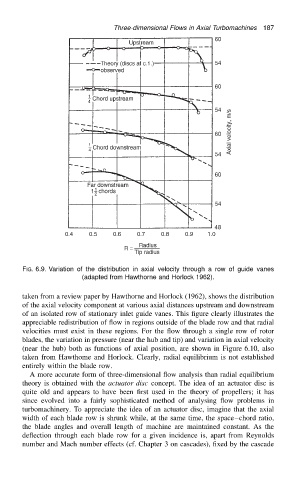
                          FIG. 6.9. Variation of the distribution in axial velocity through a row of guide vanes
                                          (adapted from Hawthorne and Horlock 1962).

                          taken from a review paper by Hawthorne and Horlock (1962), shows the distribution
                          of the axial velocity component at various axial distances upstream and downstream
                          of an isolated row of stationary inlet guide vanes. This figure clearly illustrates the
                          appreciable redistribution of flow in regions outside of the blade row and that radial
                          velocities must exist in these regions. For the flow through a single row of rotor
                          blades, the variation in pressure (near the hub and tip) and variation in axial velocity
                          (near the hub) both as functions of axial position, are shown in Figure 6.10, also
                          taken from Hawthome and Horlock. Clearly, radial equilibrium is not established
                          entirely within the blade row.
                            A more accurate form of three-dimensional flow analysis than radial equilibrium
                          theory is obtained with the actuator disc concept. The idea of an actuator disc is
                          quite old and appears to have been first used in the theory of propellers; it has
                          since evolved into a fairly sophisticated method of analysing flow problems in
                          turbomachinery. To appreciate the idea of an actuator disc, imagine that the axial
                          width of each blade row is shrunk while, at the same time, the space chord ratio,
                          the blade angles and overall length of machine are maintained constant. As the
                          deflection through each blade row for a given incidence is, apart from Reynolds
                          number and Mach number effects (cf. Chapter 3 on cascades), fixed by the cascade

