


Page 210 - Fluid Mechanics and Thermodynamics of Turbomachinery
P. 210
Three-dimensional Flows in Axial Turbomachines 191


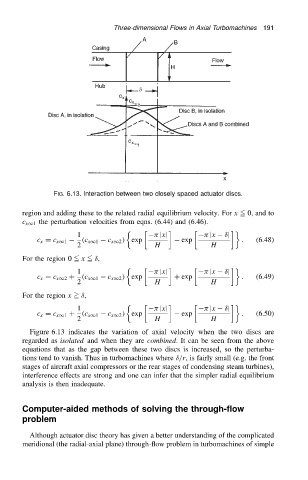
                                  FIG. 6.13. Interaction between two closely spaced actuator discs.

                          region and adding these to the related radial equilibrium velocity. For x 5 0, and to
                          c x11 the perturbation velocities from eqns. (6.44) and (6.46).

                                         1                      jxj           jx  υj
                              c x D c x11  .c x11  c x12 / exp        exp             .   (6.48)
                                         2                    H               H
                          For the region 0 5 x 5 υ,

                                         1                      jxj           jx  υj
                              c x D c x12 C .c x11  c x12 / exp     C exp             .   (6.49)
                                         2                    H               H
                          For the region x = υ,

                                         1                      jxj           jx  υj
                              c x D c x11 C .c x11  c x12 / exp       exp             .   (6.50)
                                         2                    H               H
                            Figure 6.13 indicates the variation of axial velocity when the two discs are
                          regarded as isolated and when they are combined. It can be seen from the above
                          equations that as the gap between these two discs is increased, so the perturba-
                          tions tend to vanish. Thus in turbomachines where υ/r, is fairly small (e.g. the front
                          stages of aircraft axial compressors or the rear stages of condensing steam turbines),
                          interference effects are strong and one can infer that the simpler radial equilibrium
                          analysis is then inadequate.


                          Computer-aided methods of solving the through-flow
                          problem

                            Although actuator disc theory has given a better understanding of the complicated
                          meridional (the radial-axial plane) through-flow problem in turbomachines of simple

