


Page 212 - Fluid Mechanics and Thermodynamics of Turbomachinery
P. 212
Three-dimensional Flows in Axial Turbomachines 193
                                                              L.E.
                                                                   T.E.
                                       20

                                       Radius, r (cm)  15


                                       10
                                                                       T.E.
                                                              L.E.
                                                0        5         10       15
                                                        Axial distance, Z (cm)
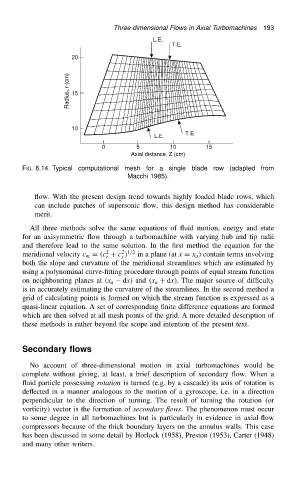
                          FIG. 6.14. Typical computational mesh for a single blade row (adapted from
                                                       Macchi 1985).

                             flow. With the present design trend towards highly loaded blade rows, which
                             can include patches of supersonic flow, this design method has considerable
                             merit.
                            All three methods solve the same equations of fluid motion, energy and state
                          for an axisymmetric flow through a turbomachine with varying hub and tip radii
                          and therefore lead to the same solution. In the first method the equation for the
                                                 2
                                                     2 1/2
                          meridional velocity c m D .c C c /  in a plane (at x D x a ) contain terms involving
                                                 r   x
                          both the slope and curvature of the meridional streamlines which are estimated by
                          using a polynominal curve-fitting procedure through points of equal stream function
                                                      dx/ and .x a C dx/. The major source of difficulty
                          on neighbouring planes at .x a
                          is in accurately estimating the curvature of the streamlines. In the second method a
                          grid of calculating points is formed on which the stream function is expressed as a
                          quasi-linear equation. A set of corresponding finite difference equations are formed
                          which are then solved at all mesh points of the grid. A more detailed description of
                          these methods is rather beyond the scope and intention of the present text.


                          Secondary flows

                            No account of three-dimensional motion in axial turbomachines would be
                          complete without giving, at least, a brief description of secondary flow. When a
                          fluid particle possessing rotation is turned (e.g. by a cascade) its axis of rotation is
                          deflected in a manner analogous to the motion of a gyroscope, i.e. in a direction
                          perpendicular to the direction of turning. The result of turning the rotation (or
                          vorticity) vector is the formation of secondary flows. The phenomenon must occur
                          to some degree in all turbomachines but is particularly in evidence in axial-flow
                          compressors because of the thick boundary layers on the annulus walls. This case
                          has been discussed in some detail by Horlock (1958), Preston (1953), Carter (1948)
                          and many other writers.

