


Page 220 - Fluid Mechanics and Thermodynamics of Turbomachinery
P. 220
Centrifugal Pumps, Fans and Compressors  201
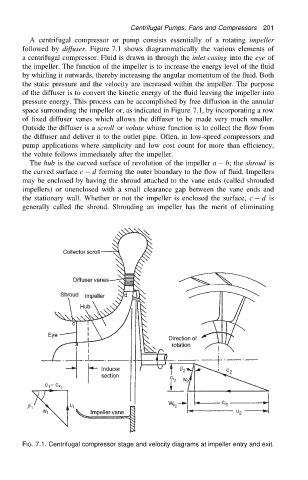
                            A centrifugal compressor or pump consists essentially of a rotating impeller
                          followed by diffuser. Figure 7.1 shows diagrammatically the various elements of
                          a centrifugal compressor. Fluid is drawn in through the inlet casing into the eye of
                          the impeller. The function of the impeller is to increase the energy level of the fluid
                          by whirling it outwards, thereby increasing the angular momentum of the fluid. Both
                          the static pressure and the velocity are increased within the impeller. The purpose
                          of the diffuser is to convert the kinetic energy of the fluid leaving the impeller into
                          pressure energy. This process can be accomplished by free diffusion in the annular
                          space surrounding the impeller or, as indicated in Figure 7.1, by incorporating a row
                          of fixed diffuser vanes which allows the diffuser to be made very much smaller.
                          Outside the diffuser is a scroll or volute whose function is to collect the flow from
                          the diffuser and deliver it to the outlet pipe. Often, in low-speed compressors and
                          pump applications where simplicity and low cost count for more than efficiency,
                          the volute follows immediately after the impeller.
                            The hub is the curved surface of revolution of the impeller a  b; the shroud is
                          the curved surface c  d forming the outer boundary to the flow of fluid. Impellers
                          may be enclosed by having the shroud attached to the vane ends (called shrouded
                          impellers) or unenclosed with a small clearance gap between the vane ends and
                          the stationary wall. Whether or not the impeller is enclosed the surface, c  d is
                          generally called the shroud. Shrouding an impeller has the merit of eliminating


                          FIG. 7.1. Centrifugal compressor stage and velocity diagrams at impeller entry and exit.

