


Page 225 - Fluid Mechanics and Thermodynamics of Turbomachinery
P. 225
206 Fluid Mechanics, Thermodynamics of Turbomachinery
                          inlet. By suitable sizing of the eye the maximum relative velocity, or some related
                          parameter, can be minimised to give the optimum inlet flow conditions. As an
                          illustration the following analysis shows a simple optimisation procedure for a low-
                          speed compressor based upon incompressible flow theory.
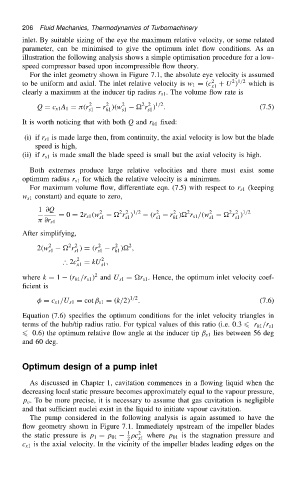
                            For the inlet geometry shown in Figure 7.1, the absolute eye velocity is assumed
                                                                                    2 1/2
                                                                              2
                          to be uniform and axial. The inlet relative velocity is w 1 D .c C U /  which is
                                                                              x1
                          clearly a maximum at the inducer tip radius r s1 . The volume flow rate is
                                                 2
                                                           2 2 1/2
                              Q D c x1 A 1 D  .r 2  r /.w 2   r /  .                      (7.5)
                                            s1   h1  s1     s1
                          It is worth noticing that with both Q and r h1 fixed:
                          (i) if r s1 is made large then, from continuity, the axial velocity is low but the blade
                             speed is high,
                          (ii) if r s1 is made small the blade speed is small but the axial velocity is high.
                            Both extremes produce large relative velocities and there must exist some
                          optimum radius r s1 for which the relative velocity is a minimum.
                            For maximum volume flow, differentiate eqn. (7.5) with respect to r s1 (keeping
                          w s1 constant) and equate to zero,
                              1 ∂Q             2     2 2 1/2   2   2   2     2     2 2 1/2
                                    D 0 D 2r s1 .w   r /    .r    r / r s1 /.w   r /
                                               s1     s1       s1  h1        s1     s1
                                ∂r s1
                          After simplifying,

                                                   2
                                                       2
                                       2 2
                              2.w 2   r / D .r 2  r / ,
                                 s1     s1     s1  h1
                                                2
                                     ∴ 2c 2  D kU ,
                                         x1     s1
                                              2
                          where k D 1  .r h1 /r s1 / and U s1 D r s1 . Hence, the optimum inlet velocity coef-
                          ficient is
                                D c x1 /U s1 D cot ˇ s1 D .k/2/ 1/2 .                      (7.6)
                          Equation (7.6) specifies the optimum conditions for the inlet velocity triangles in
                          terms of the hub/tip radius ratio. For typical values of this ratio (i.e. 0.3 6 r h1 /r s1
                          6 0.6) the optimum relative flow angle at the inducer tip ˇ s1 lies between 56 deg
                          and 60 deg.


                          Optimum design of a pump inlet

                            As discussed in Chapter 1, cavitation commences in a flowing liquid when the
                          decreasing local static pressure becomes approximately equal to the vapour pressure,
                          p v . To be more precise, it is necessary to assume that gas cavitation is negligible
                          and that sufficient nuclei exist in the liquid to initiate vapour cavitation.
                            The pump considered in the following analysis is again assumed to have the
                          flow geometry shown in Figure 7.1. Immediately upstream of the impeller blades
                                                       1  2
                          the static pressure is p 1 D p 01   c x1  where p 01 is the stagnation pressure and
                                                       2
                          c x1 is the axial velocity. In the vicinity of the impeller blades leading edges on the

