


Page 223 - Fluid Mechanics and Thermodynamics of Turbomachinery
P. 223
204 Fluid Mechanics, Thermodynamics of Turbomachinery
2
2
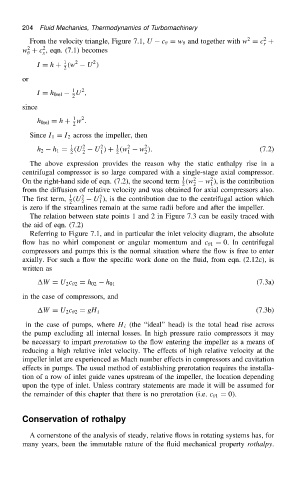
From the velocity triangle, Figure 7.1, U c D w and together with w D c C
r
2
2
w C c , eqn. (7.1) becomes
x
1
2
I D h C .w 2 U /
2
or
1 2
I D h 0rel U ,
2
since
2
1
h 0rel D h C w .
2
Since I 1 D I 2 across the impeller, then
1
2
2
1
h 1 D .U 2 U / C .w 2 w /. (7.2)
h 2 2 1 1 2
2 2
The above expression provides the reason why the static enthalpy rise in a
centrifugal compressor is so large compared with a single-stage axial compressor.
1
2
On the right-hand side of eqn. (7.2), the second term .w 2 w /, is the contribution
2 2 1
from the diffusion of relative velocity and was obtained for axial compressors also.
1
2
The first term, .U 2 U /, is the contribution due to the centrifugal action which
2 2 1
is zero if the streamlines remain at the same radii before and after the impeller.
The relation between state points 1 and 2 in Figure 7.3 can be easily traced with
the aid of eqn. (7.2)
Referring to Figure 7.1, and in particular the inlet velocity diagram, the absolute
flow has no whirl component or angular momentum and c 1 D 0. In centrifugal
compressors and pumps this is the normal situation where the flow is free to enter
axially. For such a flow the specific work done on the fluid, from eqn. (2.12c), is
written as
W D U 2 c 2 D h 02 h 01 (7.3a)
in the case of compressors, and
(7.3b)
W D U 2 c 2 D gH i
in the case of pumps, where H i (the “ideal” head) is the total head rise across
the pump excluding all internal losses. In high pressure ratio compressors it may
be necessary to impart prerotation to the flow entering the impeller as a means of
reducing a high relative inlet velocity. The effects of high relative velocity at the
impeller inlet are experienced as Mach number effects in compressors and cavitation
effects in pumps. The usual method of establishing prerotation requires the installa-
tion of a row of inlet guide vanes upstream of the impeller, the location depending
upon the type of inlet. Unless contrary statements are made it will be assumed for
the remainder of this chapter that there is no prerotation (i.e. c 1 D 0/.
Conservation of rothalpy
A cornerstone of the analysis of steady, relative flows in rotating systems has, for
many years, been the immutable nature of the fluid mechanical property rothalpy.

