


Page 239 - Fluid Mechanics and Thermodynamics of Turbomachinery
P. 239
220 Fluid Mechanics, Thermodynamics of Turbomachinery
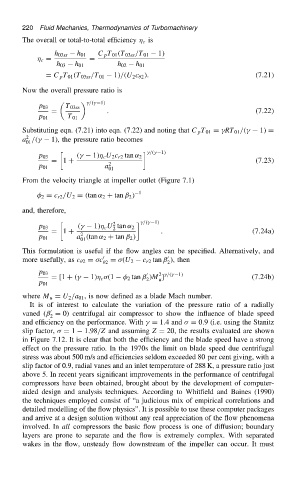
                          The overall or total-to-total efficiency   c is
                                                               1/
                                   h 03ss  h 01  C p T 01 .T 03ss /T 01
                                c D         D
                                   h 03  h 01       h 02  h 01
                                                   1//.U 2 c  2 /.                        .7.21/
                                D C p T 01 .T 03ss /T 01
                          Now the overall pressure ratio is

/.
 1/
                              p 03    T 03ss
                                  D              .                                        (7.22/
                              p 01    T 01
                          Substituting eqn. (7.21) into eqn. (7.22) and noting that C p T 01 D
RT 01 /.
  1/ D
                           2
                          a /.
   1/, the pressure ratio becomes
                           01

/.
 1/
                              p 03       .
  1/  c U 2 c r2 tan ˛ 2
                                  D 1 C           2                                       (7.23/
                              p 01               a
                                                  01
                          From the velocity triangle at impeller outlet (Figure 7.1)
                                2 D c r2 /U 2 D .tan ˛ 2 C tan ˇ 2 /  1
                          and, therefore,

                                                   2
/.
 1/
                              p 03       .
   1/  c U tan ˛ 2
                                                   2
                                  D 1 C   2                     .                        (7.24a/
                              p 01       a .tan ˛ 2 C tan ˇ 2 /
                                          01
                          This formulation is useful if the flow angles can be specified. Alternatively, and
                                                                  0
                          more usefully, as c  2 D  c 0    c r2 tan ˇ /, then
                                                 2  D  .U 2       2
                              p 03                          0  2
/.
 1/
                                  D [1 C .
  1/  c  .1    2 tan ˇ /M ]                   (7.24b/
                                                               u
                                                            2
                              p 01
                          where M u D U 2 /a 01 , is now defined as a blade Mach number.
                            It is of interest to calculate the variation of the pressure ratio of a radially
                                  0
                          vaned (ˇ D 0) centrifugal air compressor to show the influence of blade speed
                                 2
                          and efficiency on the performance. With
 D 1.4 and   D 0.9 (i.e. using the Stanitz
                          slip factor,   D 1  1.98/Z and assuming Z D 20, the results evaluated are shown
                          in Figure 7.12. It is clear that both the efficiency and the blade speed have a strong
                          effect on the pressure ratio. In the 1970s the limit on blade speed due centrifugal
                          stress was about 500 m/s and efficiencies seldom exceeded 80 per cent giving, with a
                          slip factor of 0.9, radial vanes and an inlet temperature of 288 K, a pressure ratio just
                          above 5. In recent years significant improvements in the performance of centrifugal
                          compressors have been obtained, brought about by the development of computer-
                          aided design and analysis techniques. According to Whitfield and Baines (1990)
                          the techniques employed consist of “a judicious mix of empirical correlations and
                          detailed modelling of the flow physics”. It is possible to use these computer packages
                          and arrive at a design solution without any real appreciation of the flow phenomena
                          involved. In all compressors the basic flow process is one of diffusion; boundary
                          layers are prone to separate and the flow is extremely complex. With separated
                          wakes in the flow, unsteady flow downstream of the impeller can occur. It must

