


Page 235 - Fluid Mechanics and Thermodynamics of Turbomachinery
P. 235
216 Fluid Mechanics, Thermodynamics of Turbomachinery
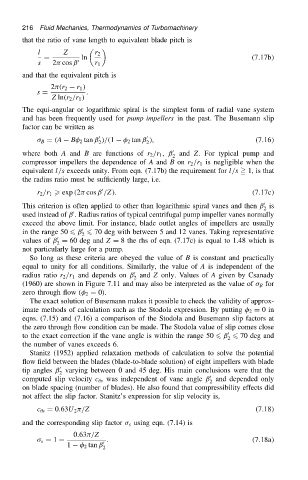
                          that the ratio of vane length to equivalent blade pitch is

                              l      Z        r 2
                                D         ln                                             (7.17b/
                              s   2  cos ˇ 0  r 1
                          and that the equivalent pitch is
                                         r 1 /
                                  2 .r 2
                              s D          .
                                  Z ln.r 2 /r 1 /
                          The equi-angular or logarithmic spiral is the simplest form of radial vane system
                          and has been frequently used for pump impellers in the past. The Busemann slip
                          factor can be written as
                                                            0
                                               0
                                B D .A  B  2 tan ˇ //.1    2 tan ˇ /,                     (7.16/
                                               2            2
                                                                   0
                          where both A and B are functions of r 2 /r 1 , ˇ and Z. For typical pump and
                                                                   2
                          compressor impellers the dependence of A and B on r 2 /r 1 is negligible when the
                          equivalent l/s exceeds unity. From eqn. (7.17b) the requirement for l/s = 1, is that
                          the radius ratio must be sufficiently large, i.e.
                                                0
                              r 2 /r 1 > exp .2  cos ˇ /Z/.                              (7.17c/
                                                                                            0
                          This criterion is often applied to other than logarithmic spiral vanes and then ˇ is
                                                                                            2
                                        0
                          used instead of ˇ . Radius ratios of typical centrifugal pump impeller vanes normally
                          exceed the above limit. For instance, blade outlet angles of impellers are usually
                                          0
                          in the range 50 6 ˇ 6 70 deg with between 5 and 12 vanes. Taking representative
                                          2
                                   0
                          values of ˇ D 60 deg and Z D 8 the rhs of eqn. (7.17c) is equal to 1.48 which is
                                   2
                          not particularly large for a pump.
                            So long as these criteria are obeyed the value of B is constant and practically
                          equal to unity for all conditions. Similarly, the value of A is independent of the
                                                         0
                          radius ratio r 2 /r 1 and depends on ˇ and Z only. Values of A given by Csanady
                                                         2
                          (1960) are shown in Figure 7.11 and may also be interpreted as the value of   B for
                          zero through flow (  2 D 0).
                            The exact solution of Busemann makes it possible to check the validity of approx-
                          imate methods of calculation such as the Stodola expression. By putting   2 D 0in
                          eqns. (7.15) and (7.16) a comparison of the Stodola and Busemann slip factors at
                          the zero through flow condition can be made. The Stodola value of slip comes close
                                                                                  0
                          to the exact correction if the vane angle is within the range 50 6 ˇ 6 70 deg and
                                                                                  2
                          the number of vanes exceeds 6.
                            Stanitz (1952) applied relaxation methods of calculation to solve the potential
                          flow field between the blades (blade-to-blade solution) of eight impellers with blade
                                    0
                          tip angles ˇ varying between 0 and 45 deg. His main conclusions were that the
                                    2
                                                                             0
                          computed slip velocity c  s was independent of vane angle ˇ and depended only
                                                                             2
                          on blade spacing (number of blades). He also found that compressibility effects did
                          not affect the slip factor. Stanitz’s expression for slip velocity is,
                              c  s D 0.63U 2  /Z                                          (7.18/
                          and the corresponding slip factor   s using eqn. (7.14) is
                                        0.63 /Z
                                s D 1            .                                       (7.18a/
                                      1     2 tan ˇ 0
                                                2

