


Page 233 - Fluid Mechanics and Thermodynamics of Turbomachinery
P. 233
214 Fluid Mechanics, Thermodynamics of Turbomachinery
                          The relative eddy concept

                            Suppose that an irrotational and frictionless fluid flow is possible which passes
                          through an impeller. If the absolute flow enters the impeller without spin, then at
                          outlet the spin of the absolute flow must still be zero. The impeller itself has an
                          angular velocity  so that, relative to the impeller, the fluid has an angular velocity
                          of  ; this is the termed the relative eddy. A simple explanation for the slip effect
                          in an impeller is obtained from the idea of a relative eddy.
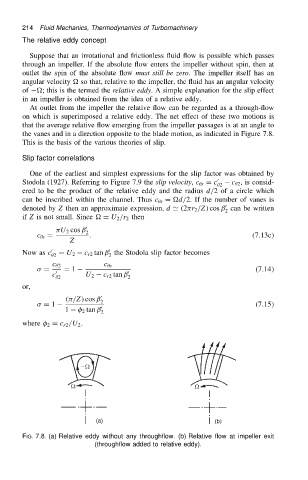
                            At outlet from the impeller the relative flow can be regarded as a through-flow
                          on which is superimposed a relative eddy. The net effect of these two motions is
                          that the average relative flow emerging from the impeller passages is at an angle to
                          the vanes and in a direction opposite to the blade motion, as indicated in Figure 7.8.
                          This is the basis of the various theories of slip.
                          Slip factor correlations

                            One of the earliest and simplest expressions for the slip factor was obtained by
                          Stodola (1927). Referring to Figure 7.9 the slip velocity, c  s D c 0  c  2 , is consid-
                                                                                 2
                          ered to be the product of the relative eddy and the radius d/2 of a circle which
                          can be inscribed within the channel. Thus c  s D d/2. If the number of vanes is
                                                                                  0
                          denoted by Z then an approximate expression, d ' .2 r 2 /Z/ cos ˇ can be written
                                                                                  2
                          if Z is not small. Since  D U 2 /r 2 then
                                    U 2 cos ˇ 0 2
                              c  s D        .                                            (7.13c/
                                       Z
                                                  0
                          Now as c 0       c r2 tan ˇ the Stodola slip factor becomes
                                   2  D U 2       2
                                  c  2          c  s
                                D  0  D 1              0                                  (7.14/
                                  c             c r2 tan ˇ
                                    2      U 2         2
                          or,
                                      . /Z/ cos ˇ 0 2
                                D 1                                                       (7.15/
                                      1    2 tan ˇ 0
                                               2
                          where   2 D c r2 /U 2 .


                          FIG. 7.8. (a) Relative eddy without any throughflow. (b) Relative flow at impeller exit
                                              (throughflow added to relative eddy).

