


Page 240 - Fluid Mechanics and Thermodynamics of Turbomachinery
P. 240
Centrifugal Pumps, Fans and Compressors  221


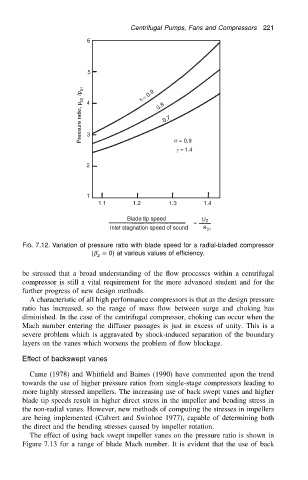
                          FIG. 7.12. Variation of pressure ratio with blade speed for a radial-bladed compressor
                                               0
                                             (ˇ D 0) at various values of efficiency.
                                              2
                          be stressed that a broad understanding of the flow processes within a centrifugal
                          compressor is still a vital requirement for the more advanced student and for the
                          further progress of new design methods.
                            A characteristic of all high performance compressors is that as the design pressure
                          ratio has increased, so the range of mass flow between surge and choking has
                          diminished. In the case of the centrifugal compressor, choking can occur when the
                          Mach number entering the diffuser passages is just in excess of unity. This is a
                          severe problem which is aggravated by shock-induced separation of the boundary
                          layers on the vanes which worsens the problem of flow blockage.

                          Effect of backswept vanes

                            Came (1978) and Whitfield and Baines (1990) have commented upon the trend
                          towards the use of higher pressure ratios from single-stage compressors leading to
                          more highly stressed impellers. The increasing use of back swept vanes and higher
                          blade tip speeds result in higher direct stress in the impeller and bending stress in
                          the non-radial vanes. However, new methods of computing the stresses in impellers
                          are being implemented (Calvert and Swinhoe 1977), capable of determining both
                          the direct and the bending stresses caused by impeller rotation.
                            The effect of using back swept impeller vanes on the pressure ratio is shown in
                          Figure 7.13 for a range of blade Mach number. It is evident that the use of back

