


Page 243 - Fluid Mechanics and Thermodynamics of Turbomachinery
P. 243
224 Fluid Mechanics, Thermodynamics of Turbomachinery


                                                                    b 2  =  0
                                                                     ¢
                                                                           15°
                             1.2
                                                                              30°


                           M 2                                                   45°


                             0.8


                             0.4
                               0.8                 1.2                 1.6                  2.0
                                                       Blade Mach number, M u
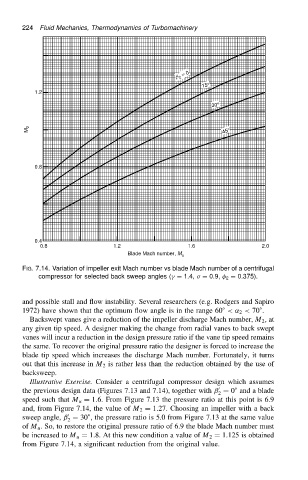
                          FIG. 7.14. Variation of impeller exit Mach number vs blade Mach number of a centrifugal
                              compressor for selected back sweep angles (
 D 1.4,   D 0.9,   2 D 0.375).


                          and possible stall and flow instability. Several researchers (e.g. Rodgers and Sapiro
                          1972) have shown that the optimum flow angle is in the range 60 ° <˛ 2 < 70 ° .
                            Backswept vanes give a reduction of the impeller discharge Mach number, M 2 ,at
                          any given tip speed. A designer making the change from radial vanes to back swept
                          vanes will incur a reduction in the design pressure ratio if the vane tip speed remains
                          the same. To recover the original pressure ratio the designer is forced to increase the
                          blade tip speed which increases the discharge Mach number. Fortunately, it turns
                          out that this increase in M 2 is rather less than the reduction obtained by the use of
                          backsweep.
                            Illustrative Exercise. Consider a centrifugal compressor design which assumes
                                                                                0
                          the previous design data (Figures 7.13 and 7.14), together with ˇ D 0 ° and a blade
                                                                                2
                          speed such that M u D 1.6. From Figure 7.13 the pressure ratio at this point is 6.9
                          and, from Figure 7.14, the value of M 2 D 1.27. Choosing an impeller with a back
                                      0
                          sweep angle, ˇ D 30 ° , the pressure ratio is 5.0 from Figure 7.13 at the same value
                                      2
                          of M u . So, to restore the original pressure ratio of 6.9 the blade Mach number must
                          be increased to M u D 1.8. At this new condition a value of M 2 D 1.125 is obtained
                          from Figure 7.14, a significant reduction from the original value.

