


Page 248 - Fluid Mechanics and Thermodynamics of Turbomachinery
P. 248
Centrifugal Pumps, Fans and Compressors  229


                              240
                                                                             a 2  =  80°


                              160
                             (deg)
                            Dq                                                 70°


                               80                                              60°


                                1.2                       1.6                   2.0
                                                             r /r
                                                              3 2
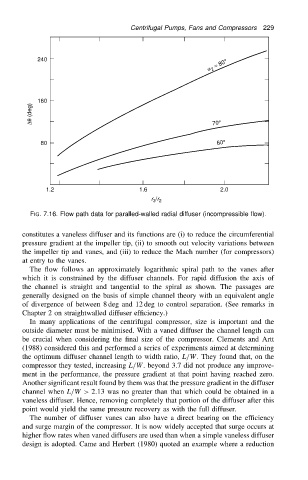
                            FIG. 7.16. Flow path data for paralled-walled radial diffuser (incompressible flow).


                          constitutes a vaneless diffuser and its functions are (i) to reduce the circumferential
                          pressure gradient at the impeller tip, (ii) to smooth out velocity variations between
                          the impeller tip and vanes, and (iii) to reduce the Mach number (for compressors)
                          at entry to the vanes.
                            The flow follows an approximately logarithmic spiral path to the vanes after
                          which it is constrained by the diffuser channels. For rapid diffusion the axis of
                          the channel is straight and tangential to the spiral as shown. The passages are
                          generally designed on the basis of simple channel theory with an equivalent angle
                          of divergence of between 8 deg and 12 deg to control separation. (See remarks in
                          Chapter 2 on straightwalled diffuser efficiency.)
                            In many applications of the centrifugal compressor, size is important and the
                          outside diameter must be minimised. With a vaned diffuser the channel length can
                          be crucial when considering the final size of the compressor. Clements and Artt
                          (1988) considered this and performed a series of experiments aimed at determining
                          the optimum diffuser channel length to width ratio, L/W. They found that, on the
                          compressor they tested, increasing L/W. beyond 3.7 did not produce any improve-
                          ment in the performance, the pressure gradient at that point having reached zero.
                          Another significant result found by them was that the pressure gradient in the diffuser
                          channel when L/W > 2.13 was no greater than that which could be obtained in a
                          vaneless diffuser. Hence, removing completely that portion of the diffuser after this
                          point would yield the same pressure recovery as with the full diffuser.
                            The number of diffuser vanes can also have a direct bearing on the efficiency
                          and surge margin of the compressor. It is now widely accepted that surge occurs at
                          higher flow rates when vaned diffusers are used than when a simple vaneless diffuser
                          design is adopted. Came and Herbert (1980) quoted an example where a reduction

