


Page 249 - Fluid Mechanics and Thermodynamics of Turbomachinery
P. 249
230 Fluid Mechanics, Thermodynamics of Turbomachinery
                          of the number of diffuser vanes from 29 to 13 caused a significant improvement in
                          the surge margin. Generally, it is accepted that it is better to have fewer diffuser
                          vanes than impeller vanes in order to achieve a wide range of surge-free flow.
                            With several adjacent diffuser passages sharing the gas from one impeller passage,
                          the uneven velocity distribution from that passage results in alternate diffuser
                          passages being either starved or choked. This is an unstable situation leading to
                          flow reversal in the passages and to surge of the compressor. When the number of
                          diffuser passages is less than the number of impeller passages a more uniform total
                          flow results.


                          Choking in a compressor stage

                            When the through flow velocity in a passage reaches the speed of sound at some
                          cross-section, the flow chokes. For the stationary inlet passage this means that no
                          further increase in mass flow is possible, either by decreasing the back pressure or
                          by increasing the rotational speed. Now the choking behaviour of rotating passages
                          differs from that of stationary passages, making separate analyzes for the inlet,
                          impeller and diffuser a necessity. For each component a simple, one-dimensional
                          approach is used assuming that all flow processes are adiabatic and that the fluid is
                          a perfect gas.
                          Inlet

                                                     2
                                                                                1 2
                                                         2
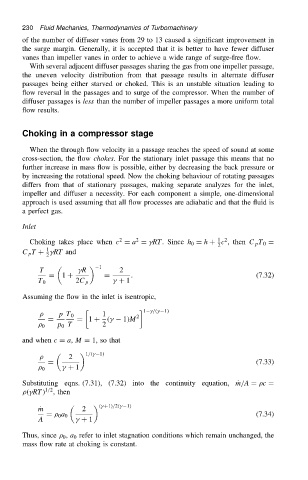
                            Choking takes place when c D a D
RT. Since h 0 D h C c , then C p T 0 D
                                                                                2
                                1
                          C p T C
RT and
                                2
                                               1
                               T
R          2
                                 D   1 C        D       .                                 (7.32)
                              T 0        2C p
 C 1
                          Assuming the flow in the inlet is isentropic,
                                                            1
/.
 1/
                                    p T 0       1        2
                                 D       D 1 C .
     1/M
                                0  p 0 T        2
                          and when c D a, M D 1, so that
                                            1/.
 1/
                                       2
                                 D                                                        (7.33)
                                0
 C 1
                          Substituting eqns. (7.31), (7.32) into the continuity equation, m/A D  c D
                                                                                     P
                           .
RT/ 1/2 , then
                                               .
C1//2.
 1/
                               P m        2
                                D   0 a 0                                                 (7.34)
                              A
 C 1
                          Thus, since   0 , a 0 refer to inlet stagnation conditions which remain unchanged, the
                          mass flow rate at choking is constant.

