


Page 245 - Fluid Mechanics and Thermodynamics of Turbomachinery
P. 245
226 Fluid Mechanics, Thermodynamics of Turbomachinery
0
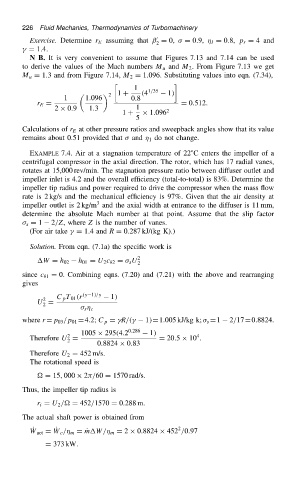
Exercise. Determine r E assuming that ˇ D 0, D 0.9, I D 0.8, p r D 4 and
2
D 1.4.
NB. It is very convenient to assume that Figures 7.13 and 7.14 can be used
to derive the values of the Mach numbers M u and M 2 . From Figure 7.13 we get
M u D 1.3 and from Figure 7.14, M 2 D 1.096. Substituting values into eqn. (7.34),
1 1/35
2 1 C .4 1/
1 1.096 0.8
r E D D 0.512.
2 ð 0.9 1.3 1 2
1 C ð 1.096
5
Calculations of r E at other pressure ratios and sweepback angles show that its value
remains about 0.51 provided that and 1 do not change.
EXAMPLE 7.4. Air at a stagnation temperature of 22 ° C enters the impeller of a
centrifugal compressor in the axial direction. The rotor, which has 17 radial vanes,
rotates at 15,000 rev/min. The stagnation pressure ratio between diffuser outlet and
impeller inlet is 4.2 and the overall efficiency (total-to-total) is 83%. Determine the
impeller tip radius and power required to drive the compressor when the mass flow
rate is 2 kg/s and the mechanical efficiency is 97%. Given that the air density at
3
impeller outlet is 2 kg/m and the axial width at entrance to the diffuser is 11 mm,
determine the absolute Mach number at that point. Assume that the slip factor
s D 1 2/Z, where Z is the number of vanes.
(For air take
D 1.4 and R D 0.287 kJ/(kg K).)
Solution. From eqn. (7.1a) the specific work is
h 01 D U 2 c 2 D s U 2
W D h 02
2
since c 1 D 0. Combining eqns. (7.20) and (7.21) with the above and rearranging
gives
C p T 01 .r .y 1//y 1/
2
U D
2
s c
where r Dp 03 /p 01 D4.2; C p D
R/.
1/D1.005 kJ/kg k; s D1 2/17D0.8824.
1005 ð 295.4.2 0.286 1/
4
2
Therefore U D D 20.5 ð 10 .
2
0.8824 ð 0.83
Therefore U 2 D 452 m/s.
The rotational speed is
D 15, 000 ð 2 /60 D 1570 rad/s.
Thus, the impeller tip radius is
r t D U 2 / D 452/1570 D 0.288 m.
The actual shaft power is obtained from
2
P W act D P W c / m DPmW/ m D 2 ð 0.8824 ð 452 /0.97
D 373 kW.

