


Page 542 - Fundamentals of Water Treatment Unit Processes : Physical, Chemical, and Biological
P. 542
Adsorption                                                                                       497


            15.5.2.3.3  Effects of Regeneration                      Solution (gist of the problem)
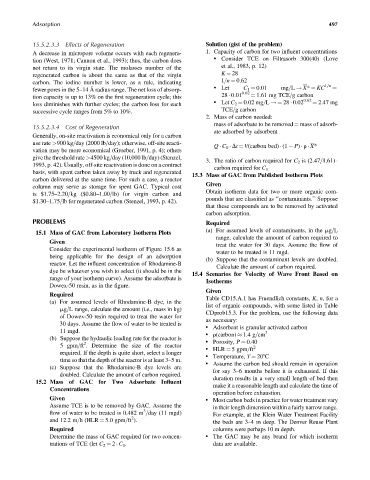
            A decrease in micropore volume occurs with each regenera-  1. Capacity of carbon for two influent concentrations
                                                                       . Consider TCE on Filtrasorb 300(40) (Love
            tion (West, 1971; Cannon et al., 1993); thus, the carbon does
            not return to its virgin state. The molasses number of the    et al., 1983, p. 12)
            regenerated carbon is about the same as that of the virgin    K ¼ 28
            carbon. The iodine number is lower, as a rule, indicating     1=n ¼ 0.62
                                                                       . Let     C 1 ¼ 0.01  mg=L ! X* ¼ KC 1=n
            fewer pores in the 5–14 Å radius range. The net loss of absorp-      0.62                         ¼
            tion capacity is up to 13% on the first regeneration cycle; this  28   0.01  ¼ 1.61 mg TCE=g carbon
                                                                       .  Let C 2 ¼ 0.02 mg=L !¼ 28   0.02 0.62 ¼ 2.47 mg
            loss diminishes with further cycles; the carbon loss for each
                                                                          TCE=g carbon
            successive cycle ranges from 5% to 10%.
                                                                     2. Mass of carbon needed:
                                                                       mass of adsorbate to be removed ¼ mass of adsorb-
            15.5.2.3.4  Cost of Regeneration
                                                                       ate adsorbed by adsorbent
            Generally, on-site reactivation is economical only for a carbon
            use rate >900 kg=day (2000 lb=day); otherwise, off-site reacti-
                                                                       Q   C 0   Dt ¼ V(carbon bed)   (1   P)   r   X*
            vation may be more economical (Groeber, 1991, p. 4); others
            give the threshold rate >4500 kg=day (10,000 lb=day) (Stenzel,
            1993, p. 42). Usually, off-site reactivation is done on a contract  3. The ratio of carbon required for C 2 is (2.47=1.61)
                                                                       carbon required for C 1
            basis, with spent carbon taken away by truck and regenerated
                                                                15.3 Mass of GAC from Published Isotherm Plots
            carbon delivered at the same time. For such a case, a reactor
                                                                     Given
            column may serve as storage for spent GAC. Typical cost
                                                                     Obtain isotherm data for two or more organic com-
            is $1.75–2.20=kg ($0.80–1.00=lb) for virgin carbon and
                                                                     pounds that are classified as ‘‘contaminants.’’ Suppose
            $1.30–1.75=lb for regenerated carbon (Stenzel, 1993, p. 42).
                                                                     that these compounds are to be removed by activated
                                                                     carbon adsorption.
            PROBLEMS                                                 Required
                                                                     (a) For assumed levels of contaminants, in the mg=L
             15.1 Mass of GAC from Laboratory Isotherm Plots
                                                                        range, calculate the amount of carbon required to
                 Given
                                                                        treat the water for 30 days. Assume the flow of
                 Consider the experimental isotherm of Figure 15.6 as
                                                                        water to be treated is 11 mgd.
                 being applicable for the design of an adsorption
                                                                     (b) Suppose that the contaminant levels are doubled.
                 reactor. Let the influent concentration of Rhodamine-B
                                                                        Calculate the amount of carbon required.
                 dye be whatever you wish to select (it should be in the
                                                                15.4 Scenarios for Velocity of Wave Front Based on
                 range of your isotherm curve). Assume the adsorbate is
                                                                     Isotherms
                 Dowex-50 resin, as in the figure.
                                                                     Given
                 Required
                                                                     Table CD15.A.1 has Fruendlich constants, K, n, for a
                 (a) For assumed levels of Rhodamine-B dye, in the
                                                                     list of organic compounds, with some listed in Table
                     mg=L range, calculate the amount (i.e., mass in kg)
                                                                     CDprob15.3. For the problem, use the following data
                     of Dowex-50 resin required to treat the water for
                                                                     as necessary:
                     30 days. Assume the flow of water to be treated is
                                                                     . Adsorbent is granular activated carbon
                     11 mgd.                                                            3
                                                                     . r(carbon)   1.4 g=cm
                 (b) Suppose the hydraulic loading rate for the reactor is  . Porosity, P ¼ 0.40
                             2
                     5 gpm=ft . Determine the size of the reactor                   2
                                                                     . HLR ¼ 5 gpm=ft
                     required. If the depth is quite short, select a longer
                                                                     .  Temperature, T ¼ 208C
                     time so that the depth of the reactor is at least 3–5m.
                                                                     . Assume the carbon bed should remain in operation
                 (c) Suppose that the Rhodamine-B dye levels are
                                                                       for say 3–6 months before it is exhausted. If this
                     doubled. Calculate the amount of carbon required.
                                                                       duration results in a very small length of bed then
             15.2 Mass of GAC for Two Adsorbate Influent
                                                                       make it a reasonable length and calculate the time of
                 Concentrations
                                                                       operation before exhaustion.
                 Given                                               . Most carbon beds in practice for water treatment vary
                 Assume TCE is to be removed by GAC. Assume the        in their length dimension within a fairly narrow range.
                                                3
                 flow of water to be treated is 0.482 m =day (11 mgd)   For example, at the Klein Water Treatment Facility
                                            2
                 and 12.2 m=h (HLR ¼ 5.0 gpm=ft ).                     the beds are 3–4 m deep. The Denver Reuse Plant
                 Required                                              columns were perhaps 10 m depth.
                 Determine the mass of GAC required for two concen-  . The GAC may be any brand for which isotherm
                 trations of TCE (let C 2 ¼ 2   C 1 .                  data are available.

