


Page 609 - Fundamentals of Water Treatment Unit Processes : Physical, Chemical, and Biological
P. 609
564                            Fundamentals of Water Treatment Unit Processes: Physical, Chemical, and Biological


                                       Fire  Conference
                         Laboratory                    Office
                                      pump     room

                                       Hall
                                                              Lobby
                        Passage  Electrical  Shop  Women Men               Concentrate  Raw water  Permeate

                                                          Operations
                                                                                             Clear-well
                                                                                F
                                                                                         P
                                                                                F
                                          Membranes                                     P
                                                                                F
                                               P         P         P                    P          De-gasing
                                                                                        P

                           Future   Future    Skid #3  Skid #2   Skid #1
                           skid #5  skid #4                                   Cleaning tanks


                                                              Chlorination cylinders
                       Acid                                                          Caustic
                              Passage  Anti-scalant  Passage  Chlorination  Passage  Passage
                                                   scrubber


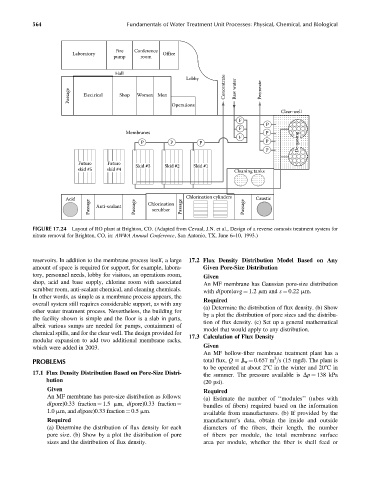
            FIGURE 17.24 Layout of RO plant at Brighton, CO. (Adapted from Cevaal, J.N. et al., Design of a reverse osmosis treatment system for
            nitrate removal for Brighton, CO, in: AWWA Annual Conference, San Antonio, TX, June 6–10, 1993.)


            reservoirs. In addition to the membrane process itself, a large  17.2 Flux Density Distribution Model Based on Any
            amount of space is required for support, for example, labora-  Given Pore-Size Distribution
            tory, personnel needs, lobby for visitors, an operations room,  Given
            shop, acid and base supply, chlorine room with associated  An MF membrane has Gaussian pore-size distribution
            scrubber room, anti-scalant chemical, and cleaning chemicals.
                                                                    with d(pore)avg ¼ 1.2 mm and s ¼ 0.22 mm.
            In other words, as simple as a membrane process appears, the
                                                                    Required
            overall system still requires considerable support, as with any
                                                                    (a) Determine the distribution of flux density. (b) Show
            other water treatment process. Nevertheless, the building for
                                                                    by a plot the distribution of pore sizes and the distribu-
            the facility shown is simple and the floor is a slab in parts,
                                                                    tion of flux density. (c) Set up a general mathematical
            albeit various sumps are needed for pumps, containment of
                                                                    model that would apply to any distribution.
            chemical spills, and for the clear well. The design provided for
                                                               17.3 Calculation of Flux Density
            modular expansion to add two additional membrane racks,
            which were added in 2003.                               Given
                                                                    An MF hollow-fiber membrane treatment plant has a
                                                                                           3
            PROBLEMS                                                total flux, Q   J w ¼ 0.657 m =s (15 mgd). The plant is
                                                                    to be operated at about 28C in the winter and 208Cin
            17.1 Flux Density Distribution Based on Pore-Size Distri-  the summer. The pressure available is Dp ¼ 138 kPa
                bution                                              (20 psi).
                 Given                                              Required
                 An MF membrane has pore-size distribution as follows:  (a) Estimate the number of ‘‘modules’’ (tubes with
                                                                    bundles of fibers) required based on the information
                 d(pore)0.33 fraction ¼ 1.5 mm, d(pore)0.33 fraction ¼
                 1.0 mm, and d(pore)0.33 fraction¼ 0.5 mm.          available from manufacturers. (b) If provided by the
                 Required                                           manufacturer’s data, obtain the inside and outside
                 (a) Determine the distribution of flux density for each  diameters of the fibers, their length, the number
                 pore size. (b) Show by a plot the distribution of pore  of fibers per module, the total membrane surface
                 sizes and the distribution of flux density.         area per module, whether the fiber is shell feed or

