


Page 606 - Fundamentals of Water Treatment Unit Processes : Physical, Chemical, and Biological
P. 606
Membrane Processes                                                                               561


            that breaches may be detected if there is such an occurrence.    Cross-flow velocity
            Cleaning is another issue; to determine when replacement
            is needed is yet another. Cleaning chemicals must be  Forward wash velocity
            ordered, stored, and utilized with special regard to safety
            and regulations. Pumps must be maintained, sensors cali-
            brated, computer outputs monitored, and samples obtained
            and sent to a laboratory; also, reporting is required along
                                                                   Permeate water side
            with archiving data.                                                                   Membrane
                                                               (a)
                                                                         Cross-flow velocity
            17.5.1 INTEGRITY TESTING
            Integrity monitoring may be continuous, periodic, both, or
            variable; some form was required by 15 states (in 2001).                            Reverse wash velocity
            Assurance of membrane capabilities is tied to integrity
            testing and monitoring. Most of this section was adapted
            from Hugaboom et al. (2003). Their work was referenced to
            six full-scale hollow-fiber MF and UF systems; some were  Permeate water side
                                                                                                   Membrane
            dead end and two had cross-flow capability. Three had per-  (b)
            meate backwash and three used permeate and air. Five were
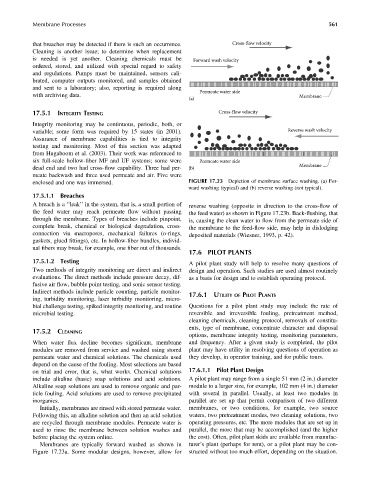
            enclosed and one was immersed.                     FIGURE 17.23 Depiction of membrane surface washing. (a) For-
                                                               ward washing (typical) and (b) reverse washing (not typical).
            17.5.1.1  Breaches
            A breach is a ‘‘leak’’ in the system, that is, a small portion of  reverse washing (opposite in direction to the cross-flow of
            the feed water may reach permeate flow without passing  the feed water) as shown in Figure 17.23b. Back-flushing, that
            through the membrane. Types of breaches include pinpoint,  is, causing the clean water to flow from the permeate side of
            complete break, chemical or biological degradation, cross-  the membrane to the feed-flow side, may help in dislodging
            connection via macropores, mechanical failures (o-rings,  deposited materials (Wiesner, 1993, p. 42).
            gaskets, glued fittings), etc. In hollow-fiber bundles, individ-
            ual fibers may break, for example, one fiber out of thousands.
                                                               17.6 PILOT PLANTS
            17.5.1.2  Testing
                                                               A pilot plant study will help to resolve many questions of
            Two methods of integrity monitoring are direct and indirect  design and operation. Such studies are used almost routinely
            evaluations. The direct methods include pressure decay, dif-  as a basis for design and to establish operating protocol.
            fusive air flow, bubble point testing, and sonic sensor testing.
            Indirect methods include particle counting, particle monitor-
                                                               17.6.1 UTILITY OF PILOT PLANTS
            ing, turbidity monitoring, laser turbidity monitoring, micro-
            bial challenge testing, spiked integrity monitoring, and routine  Questions for a pilot plant study may include the rate of
            microbial testing.                                 reversible and irreversible fouling, pretreatment method,
                                                               cleaning chemicals, cleaning protocol, removals of constitu-
                                                               ents, type of membrane, concentrate character and disposal
            17.5.2 CLEANING
                                                               options, membrane integrity testing, monitoring parameters,
            When water flux decline becomes significant, membrane  and frequency. After a given study is completed, the pilot
            modules are removed from service and washed using stored  plant may have utility in resolving questions of operation as
            permeate water and chemical solutions. The chemicals used  they develop, in operator training, and for public tours.
            depend on the cause of the fouling. Most selections are based
            on trial and error, that is, what works. Chemical solutions  17.6.1.1  Pilot Plant Design
            include alkaline (basic) soap solutions and acid solutions.  A pilot plant may range from a single 51 mm (2 in.) diameter
            Alkaline soap solutions are used to remove organic and par-  module to a larger size, for example, 102 mm (4 in.) diameter
            ticle fouling. Acid solutions are used to remove precipitated  with several in parallel. Usually, at least two modules in
            inorganics.                                        parallel are set up that permit comparison of two different
              Initially, membranes are rinsed with stored permeate water.  membranes, or two conditions, for example, two source
            Following this, an alkaline solution and then an acid solution  waters, two pretreatment modes, two cleaning solutions, two
            are recycled through membrane modules. Permeate water is  operating pressures, etc. The more modules that are set up in
            used to rinse the membrane between solution washes and  parallel, the more that may be accomplished (and the higher
            before placing the system online.                  the cost). Often, pilot plant skids are available from manufac-
              Membranes are typically forward washed as shown in  turer’s plant (perhaps for rent), or a pilot plant may be con-
            Figure 17.23a. Some modular designs, however, allow for  structed without too much effort, depending on the situation.

