


Page 601 - Fundamentals of Water Treatment Unit Processes : Physical, Chemical, and Biological
P. 601
556                            Fundamentals of Water Treatment Unit Processes: Physical, Chemical, and Biological


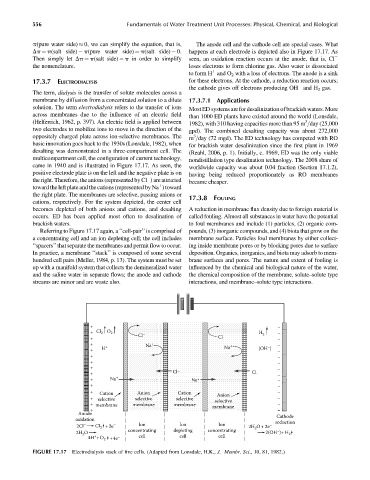
            p(pure water side)   0, we can simplify the equation, that is,  The anode cell and the cathode cell are special cases. What
            Dp¼ p(salt side)   p(pure water side) ¼ p(salt side)   0.  happens at each electrode is depicted also in Figure 17.17. As
            Then simply let Dp ¼ p(salt side) ¼ p in order to simplify  seen, an oxidation reaction occurs at the anode, that is, Cl
            the nomenclature.                                  loses electrons to form chlorine gas. Also water is dissociated
                                                               to form H and O 2 with a loss of electrons. The anode is a sink
                                                                       þ
            17.3.7 ELECTRODIALYSIS                             for these electrons. At the cathode, a reduction reaction occurs;
                                                               the cathode gives off electrons producing OH and H 2 gas.

            The term, dialysis is the transfer of solute molecules across a
            membrane by diffusion from a concentrated solution to a dilute  17.3.7.1  Applications
            solution. The term electrodialysis refers to the transfer of ions  Most ED systems are for desalinization of brackish waters. More
            across membranes due to the influence of an electric field  than 1000 ED plants have existed around the world (Lonsdale,
            (Helferrich, 1962, p. 397). An electric field is applied between  1982), with 310 having capacities more than 95 m =day (25,000
                                                                                                     3
            two electrodes to mobilize ions to move in the direction of the  gpd). The combined desalting capacity was about 272,000
            oppositely charged plate across ion-selective membranes. The  m =day (72 mgd). The ED technology has competed with RO
                                                                 3
            basic innovation goes back to the 1930s (Lonsdale, 1982), when  for brackish water desalinization since the first plant in 1969
            desalting was demonstrated in a three-compartment cell. The  (Reahl, 2006, p. 1). Initially, c. 1969, ED was the only viable
            multicompartment cell, the configuration of current technology,  nondistillation type desalination technology. The 2008 share of
            came in 1940 and is illustrated in Figure 17.17. As seen, the  worldwide capacity was about 0.04 fraction (Section 17.1.2),
            positive electrode plate is on the left and the negative plate is on  having being reduced proportionately as RO membranes
            the right. Therefore, the anions (represented by Cl ) are attracted  became cheaper.

            toward the left plate and the cations (represented by Na ) toward
                                                     þ
            the right plate. The membranes are selective, passing anions or
                                                               17.3.8 FOULING
            cations, respectively. For the system depicted, the center cell
            becomes depleted of both anions and cations, and desalting  A reduction in membrane flux density due to foreign material is
            occurs. ED has been applied most often to desalination of  called fouling. Almost all substances in water have the potential
            brackish waters.                                   to foul membranes and include (1) particles, (2) organic com-
              Referring to Figure 17.17 again, a ‘‘cell-pair’’ is comprised of  pounds, (3) inorganic compounds, and (4) biota that grow on the
            a concentrating cell and an ion depleting cell; the cell includes  membrane surface. Particles foul membranes by either collect-
            ‘‘spacers’’ that separate the membranes and permit flow to occur.  ing inside membrane pores or by blocking pores due to surface
            In practice, a membrane ‘‘stack’’ is composed of some several  deposition. Organics, inorganics, and biota may adsorb to mem-
            hundred cell pairs (Meller, 1984, p. 13). The system must be set  brane surfaces and pores. The nature and extent of fouling is
            up with a manifold system that collects the demineralized water  influenced by the chemical and biological nature of the water,
            and the saline water in separate flows; the anode and cathode  the chemical composition of the membrane, solute–solute type
            streams are minor and are waste also.              interactions, and membrane–solute type interactions.


                               +                                                            –
                               + Cl 2 O 2       –                                     H     –
                                              Cl                          –            2
                               +                                         Cl                 –
                               +    +            Na +                        +           –  –
                               +  H                                        Na         (OH )  –
                               +                                                            –
                               +                                                            –
                               +                                                            –
                                                          Cl –                      Cl –
                               +                                                            –
                               +     Na +                       Na +                        –
                               +                                                            –
                               +  Cation      Anion         Cation      Anion               –
                               +  selective  selective     selective    selective           –
                               +  membrane   membrane     membrane     membrane             –
                               +                                                            –
                           Anode
                                                                                            Cathode
                          oxidation                                                         reduction
                          2Cl –  Cl 2 +2e –    Ion          Ion          Ion       2H O+ 2e –
                                                                                     2
                                                                                            –
                          2H O             concentrating  depleting  concentrating      2(OH )+ H 2
                            2
                                +
                              4H +O 2 +4e –    cell         cell         cell
            FIGURE 17.17 Electrodialysis stack of five cells. (Adapted from Lonsdale, H.K., J. Membr. Sci., 10, 81, 1982.)

