


Page 603 - Fundamentals of Water Treatment Unit Processes : Physical, Chemical, and Biological
P. 603
558                            Fundamentals of Water Treatment Unit Processes: Physical, Chemical, and Biological


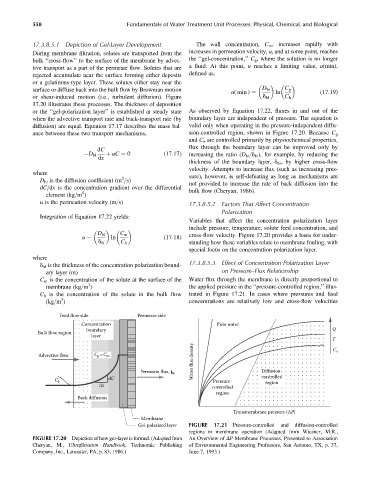
            17.3.8.5.1  Depiction of Gel-Layer Development        The wall concentration, C m , increases rapidly with
            During membrane filtration, solutes are transported from the  increases in permeation velocity, u, and at some point, reaches
            bulk ‘‘cross-flow’’ to the surface of the membrane by advec-  the ‘‘gel-concentration,’’ C g , where the solution is no longer
            tive transport as a part of the permeate flow. Solutes that are  a fluid. At this point, u reaches a limiting value, u(min),
            rejected accumulate near the surface forming either deposits  defined as,
            or a gelatinous-type layer. These solutes either stay near the
            surface or diffuse back into the bulk flow by Brownian motion               D bl    C g
                                                                             u( min ) ¼     ln            (17:19)
            or shear-induced motion (i.e., turbulent diffusion). Figure                d bl    C b
            17.20 illustrates these processes. The thickness of deposition
            or the ‘‘gel-polarization layer’’ is established at steady state  As observed by Equation 17.22, fluxes in and out of the
            when the advective transport rate and back-transport rate (by  boundary layer are independent of pressure. The equation is
            diffusion) are equal. Equation 17.17 describes the mass bal-  valid only when operating in the pressure-independent diffu-
            ance between these two transport mechanisms,       sion-controlled region, shown in Figure 17.20. Because C g
                                                               and C b are controlled primarily by physiochemical properties,
                                                               flux through the boundary layer can be improved only by
                                 dC
                              D bl  þ uC ¼ 0           (17:17)  increasing the ratio (D bl =d bl ), for example, by reducing the
                                 dx
                                                               thickness of the boundary layer, d bl , by higher cross-flow
                                                               velocity. Attempts to increase flux (such as increasing pres-
            where
                                         2                     sure), however, is self-defeating as long as mechanisms are
              D bl is the diffusion coefficient (m =s)
                                                               not provided to increase the rate of back diffusion into the
              dC=dx is the concentration gradient over the differential
                            4                                  bulk flow (Cheryan, 1986).
                element (kg=m )
              u is the permeation velocity (m=s)               17.3.8.5.2  Factors That Affect Concentration
                                                                          Polarization
              Integration of Equation 17.22 yields:
                                                               Variables that affect the concentration polarization layer
                                                               include pressure, temperature, solute feed concentration, and

                                 D bl    C m                   cross-flow velocity. Figure 17.20 provides a basis for under-
                                      ln               (17:18)
                            u ¼
                                 d bl    C b                   standing how these variables relate to membrane fouling, with
                                                               special focus on the concentration polarization layer.
            where
                                                               17.3.8.5.3  Effect of Concentration Polarization Layer
              d bl is the thickness of the concentration polarization bound-
                ary layer (m)                                             on Pressure–Flux Relationship
              C m is the concentration of the solute at the surface of the  Water flux through the membrane is directly proportional to
                              3
                membrane (kg=m )                               the applied pressure in the ‘‘pressure-controlled region,’’ illus-
              C b is the concentration of the solute in the bulk flow  trated in Figure 17.21. In cases where pressures and feed
                     3
                (kg=m )                                        concentrations are relatively low and cross-flow velocities
                     Feed flow side           Permeate side
                            Concentration                               Pure water
                             boundary                                                                         Q
             Bulk flow region
                               layer
                                                                                                              T
                                                                Water flux density
              Advective flow    C = C m                                                                        C o
                                 g
                                               Permeate flux, j w                      Diffusion-
                                     dC                                                controlled
                   C b                                                 Pressure-        region
                                  dx
                                                                       controlled
                                                                        region
                           Back diffusion
                                                                              Transmembrane pressure (ΔP)
                                               Membrane
                                              Gel-polarized layer  FIGURE  17.21 Pressure-controlled  and  diffusion-controlled
                                                               regions in membrane operation (Adapted from Wiesner, M.R.,
            FIGURE 17.20  Depiction of how gel-layer is formed. (Adapted from  An Overview of DP Membrane Processes, Presented to Association
            Cheryan, M., Ultrafiltration Handbook,Technomic Publishing  of Environmental Engineering Professors, San Antonio, TX, p. 37,
            Company, Inc., Lancaster, PA, p. 83, 1986.)        June 7, 1993.)

