


Page 605 - Fundamentals of Water Treatment Unit Processes : Physical, Chemical, and Biological
P. 605
560                            Fundamentals of Water Treatment Unit Processes: Physical, Chemical, and Biological


                                                       1st stage             2nd stage
                                                    concentrate water     concentrate water
                                                    TOC= 13.3 mg/L        TOC=19.9 mg/L
                                                    Ca =39 mg/L           Ca=57 mg/L
                                                                                                Discharged
                                                                                                concentrate

                                                                                                Water
                                                                                                  3
                   Feed water                                                                 950 m /day
                                                                                               TOC=39.7 mg/L
                Q = 3785 m 3 /day
                  (1.0 mgd)                                                                    Ca=111 mg/L
                TOC = 10 mg/L
                Ca = 30 mg/L


                                                  1st stage              2nd stage             3rd stage
                                                permeate water         permeate water        permeate water
                                                                          3
                                                    3
                                                                                                 3
                                                950 m /day (0.25 mgd)  950 m /day (0.25 mgd)  950 m /day (0.25 mgd)
                                                  TOC= 0.1 mg/L        TOC=0.1 mg/L            TOC=0.1 mg/L
                                                  Ca=3 mg/L            Ca=3 mg/L               Ca=3 mg/L
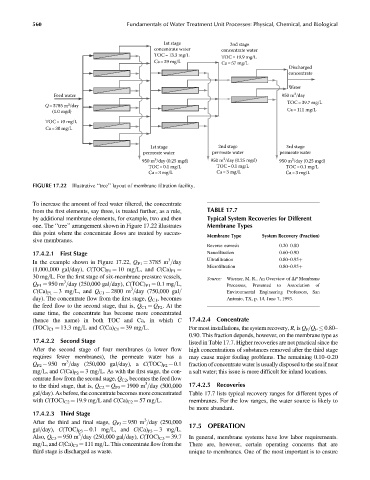
            FIGURE 17.22 Illustrative ‘‘tree’’ layout of membrane filtration facility.

            To increase the amount of feed water filtered, the concentrate
            from the first elements, say three, is treated further, as a rule,  TABLE 17.7
            by additional membrane elements, for example, two and then  Typical System Recoveries for Different
            one. The ‘‘tree’’ arrangement shown in Figure 17.22 illustrates  Membrane Types
            this point where the concentrate flows are treated by succes-
                                                                     Membrane Type     System Recovery (Fraction)
            sive membranes.
                                                                     Reverse osmosis         0.20–0.80
            17.4.2.1  First Stage                                    Nanofiltration           0.60–0.90
                                                        3
            In the example shown in Figure 17.22, Q F1 ¼ 3785 m =day  Ultrafiltration         0.80–0.95þ
                                                                     Microfiltration          0.80–0.95þ
            (1,000,000 gal=day), C(TOC) F1 ¼ 10 mg=L, and C(Ca) F1 ¼
            30 mg=L. For the first stage of six-membrane pressure vessels,  Source: Wiesner, M. R., An Overview of DP Membrane
                      3
            Q P1 ¼ 950 m =day (250,000 gal=day), C(TOC) P1 ¼ 0.1 mg=L,      Processes,  Presented  to  Association  of
                                            3
            C(Ca) P1 ¼ 3mg=L, and Q C1 ¼ 2800 m =day (750,000 gal=          Environmental Engineering Professors, San
            day). The concentrate flow from the first stage, Q C1 , becomes   Antonio, TX, p. 14, June 7, 1993.
            the feed flow to the second stage, that is, Q C1 ¼ Q F2 . At the
            same time, the concentrate has become more concentrated
            (hence the name) in both TOC and Ca, in which C    17.4.2.4  Concentrate
            (TOC) C1 ¼ 13.3 mg=L and C(Ca) C1 ¼ 39 mg=L.       For most installations, the system recovery, R,is Q P =Q F   0.80–
                                                               0.90. This fraction depends, however, on the membrane type as
            17.4.2.2  Second Stage                             listed in Table 17.7. Higher recoveries are not practical since the
            After the second stage of four membranes (a lower flow  high concentrations of substances removed after the third stage
            requires fewer membranes), the permeate water has a  may cause major fouling problems. The remaining 0.10–0.20
                       3
            Q P2 ¼ 950 m =day (250,000 gal=day), a C(TOC) P2 ¼ 0.1  fraction of concentrate water is usually disposed to the sea if near
            mg=L, and C(Ca) P2 ¼ 3mg=L. As with the first stage, the con-  a salt water; this issue is more difficult for inland locations.
            centrate flow from the second stage, Q C2 , becomes the feed flow
                                                 3
            to the third stage, that is, Q C2 ¼ Q F3 ¼ 1900 m =day (500,000  17.4.2.5  Recoveries
            gal=day). As before, the concentrate becomes more concentrated  Table 17.7 lists typical recovery ranges for different types of
            with C(TOC) C2 ¼ 19.9 mg=Land C(Ca) C2 ¼ 57 mg=L.  membranes. For the low ranges, the water source is likely to
                                                               be more abundant.
            17.4.2.3  Third Stage
                                                 3
            After the third and final stage, Q P3 ¼ 950 m =day (250,000  17.5 OPERATION
            gal=day), C(TOC) P3 ¼ 0.1 mg=L, and C(Ca) P3 ¼ 3mg=L.
                           3
            Also, Q C3 ¼ 950 m =day (250,000 gal=day), C(TOC) C3 ¼ 39.7  In general, membrane systems have low labor requirements.
            mg=L, and C(Ca) C3 ¼ 111 mg=L. This concentrate flow from the  There are, however, certain operating concerns that are
            third stage is discharged as waste.                unique to membranes. One of the most important is to ensure

