


Page 607 - Fundamentals of Water Treatment Unit Processes : Physical, Chemical, and Biological
P. 607
562                            Fundamentals of Water Treatment Unit Processes: Physical, Chemical, and Biological


            17.6.1.2  Pilot Plant Operation                    370–480 mg=L as CaCO 3 . About 0.60 fraction of homes
            The parameters of operation may be measured manually, for  had ion-exchange units installed to reduce hardness levels.
            example, by pressure gages, sampling taps, flow, etc. or by  Seven-day THMFPs have ranged 10–1000 mg=L, which
            sensors placed at the needed locations, or both. For long-term  added impetus to the search for adequate treatment.
            operation, computer operation is most practical. For sensors, a
                                                               17.7.1.2  Brighton Pilot Plant
            ‘‘board’’ must be set up to take the signals (i.e., 4–20 ma) that
            is then interpreted by the software to give readings and pro-  A pilot plant study was initiated in October 1991 and con-
            vide for archiving and plots. Valves and pumps are operated  tinued through May 1992. Objectives were as following
            by microrelays.                                    (Cevaal et al., 1993): (1) determine THM precursor rejection
                                                               values, (2) confirm feed-water pressures and differential pres-
                                                               sures required, (3) assess fouling rates for each of the mem-
            17.7 CASE
                                                               brane elements tested, (4) obtain data on concentrate water
            The wide varieties of membrane plants in all categories, that  quality relative to a discharge permit, and (5) increase public
            is, MF, UF, NF, and RO, have been built and are in operation  awareness and acceptance of RO. Membranes evaluated
            (most are MF and RO). One case, Brighton, Colorado, is  included Hydranautics 4040 LSA NCM1t, Fluid Systems
            reviewed that illustrates some aspects of a design for an  TFCL 4821 LPt, Filmtec BW30 4040t, and a later version
            RO plant.                                          of Hydranautics 4040 LSA NCM1t. Each membrane was a
                                                               spiral-wound polyamide thin-film composite membrane. The
                                                               polyamide thin membranes were selected over CA because of
            17.7.1 CITY OF BRIGHTON REVERSE OSMOSIS WATER
                                                               their lower feed pressures and higher nitrate rejections
                    TREATMENT PLANT                            (Cevaal et al., 1993). Rejection of nitrates was about 97%
            Disposal of brine is a major consideration in application of  for the second and third membranes listed. Also  0.92 rejec-
            RO. For that reason, interior locations, such as Brighton,  tion of THMFP was achieved. Based on the pilot plant study,
            Colorado, are not common. The Brighton case also illustrates  the Fluid Systems TFCL membrane was selected.
            the many and varied aspects of an RO design.          Biological fouling was found to occur, caused by growth of
                                                               Pseudomonas. The well water showed heterotrophic plate
            17.7.1.1  Background                               counts, 500   HPC   5000 cfu=100 mL, TOC   3mg=L,
            The city of Brighton, Colorado, with a population of 14,000  and DO   6mg=L. Biological fouling was addressed in design
            in 1990, is located about 35 km (22 mi) north of the north-east  of the full-scale RO plant by well rehabilitation consisting of
            side of Denver and about 2 km east of the South Platte River.  strong acid=shock chlorine and hydrogen peroxide. Alterna-
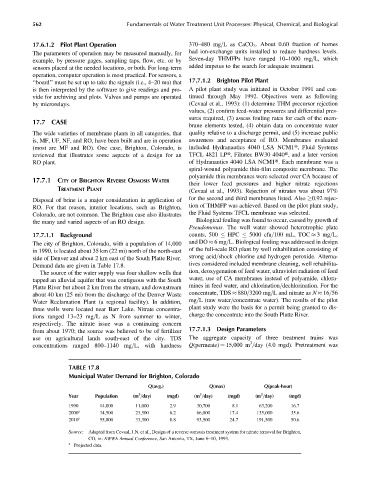
            Demand data are given in Table 17.8.               tives considered included membrane cleaning, well rehabilita-
              The source of the water supply was four shallow wells that  tion, deoxygenation of feed water, ultraviolet radiation of feed
            tapped an alluvial aquifer that was contiguous with the South  water, use of CA membranes instead of polyamide, chlora-
            Platte River but about 2 km from the stream, and downstream  mines in feed water, and chlorination=dechlorination. For the
            about 40 km (25 mi) from the discharge of the Denver Waste  concentrate, TDS   880=3200 mg=L and nitrate as N   16=56
            Water Reclamation Plant (a regional facility). In addition,  mg=L (raw water=concentrate water). The results of the pilot
            three wells were located near Barr Lake. Nitrate concentra-  plant study were the basis for a permit being granted to dis-
            tions ranged 13–23 mg=L as N from summer to winter,  charge the concentrate into the South Platte River.
            respectively. The nitrate issue was a continuing concern
            from about 1970; the source was believed to be of fertilizer  17.7.1.3  Design Parameters
            use on agricultural lands south-east of the city. TDS  The aggregate capacity of three treatment trains was
                                                                                   3
            concentrations ranged 800–1140 mg=L, with hardness  Q(permeate) ¼ 15,000 m =day (4.0 mgd). Pretreatment was


                        TABLE 17.8
                        Municipal Water Demand for Brighton, Colorado
                                                  Q(avg.)             Q(max)            Q(peak-hour)
                                                                   3
                                                                                       3
                                               3
                        Year    Population   (m =day)   (mgd)    (m =day)   (mgd)    (m =day)   (mgd)
                        1990      14,000      11,000     2.9      30,700     8.1      63,200     16.7
                        2000 a    34,500      23,500     6.2      66,000     17.4    135,000     35.6
                        2010 a    55,000      33,300     8.8      93,500     24.7    191,500     50.6
                        Source: Adapted from Cevaal, J.N. et al., Design of a reverse osmosis treatment system for nitrate removal for Brighton,
                              CO, in: AWWA Annual Conference, San Antonio, TX, June 6–10, 1993.
                        a
                         Projected data.

