


Page 602 - Fundamentals of Water Treatment Unit Processes : Physical, Chemical, and Biological
P. 602
Membrane Processes                                                                               557


            17.3.8.1  Reversible and Irreversible Fouling      17.3.8.3  Particle Fouling
            Membranes invariably foul with time. Figure 17.18 illustrates  Particles may deposit on membrane surfaces or collect within
            four fouling cycles, in which flux declines with time but is  membrane pores. Deposited particles may remain near the
            restored partially by cleaning. The fouling cycle may be  surface (e.g., gel-polarization layer or pore blockage) or they
            defined by three fouling terms, that is, (1) ‘‘total’’ fouling,  may be transported back into the bulk flow by diffusion after
            seen as the overall loss of flux; (2) reversible fouling, which  the removal by shear. At steady state, the net transport of
            is that part of total fouling that may be restored by cleaning; and  particles toward the membrane is in balance with the back-
            (3) irreversible fouling, which is that part of total fouling that is  transport mechanisms (i.e., Brownian diffusion and turbulent
            not restored by cleaning. For spiral-wound membranes, the  diffusion if the advective flow is in the turbulent regime).
            time between the cleaning cycles depends on the feed-water  Calculations performed by Wiesner and Chellam (1992)
            quality, which depends, in turn, on the ambient water quality  describing flow through thin plates showed that particles
            and the pretreatment. For spiral-wound membranes, the time  near 0.1 mm in radius would preferentially accumulate on
            between cleaning events may vary from weeks to months. Over  the surface of the membrane. Theoretically, particles less
            time, however, irreversible fouling increases to such extent that  than 0.1 mm in radius are transported primarily by Brownian
            replacement becomes economical. In the case of the RO mem-  diffusion, while particles greater than 0.1 mm in radius are
            branes at Brighton, Colorado, the membranes were replaced  transported primarily by turbulent diffusion.
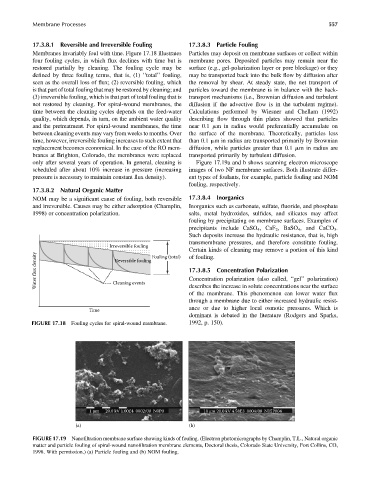
            only after several years of operation. In general, cleaning is  Figure 17.19a and b shows scanning electron microscope
            scheduled after about 10% increase in pressure (increasing  images of two NF membrane surfaces. Both illustrate differ-
            pressure is necessary to maintain constant flux density).  ent types of foulants, for example, particle fouling and NOM
                                                               fouling, respectively.
            17.3.8.2  Natural Organic Matter
            NOM may be a significant cause of fouling, both reversible  17.3.8.4  Inorganics
            and irreversible. Causes may be either adsorption (Champlin,  Inorganics such as carbonate, sulfate, fluoride, and phosphate
            1998) or concentration polarization.               salts, metal hydroxides, sulfides, and silicates may affect
                                                               fouling by precipitating on membrane surfaces. Examples of
                                                               precipitants include CaSO 4 , CaF 2 , BaSO 4 , and CaCO 3 .
                                                               Such deposits increase the hydraulic resistance, that is, high
                                                               transmembrane pressures, and therefore constitute fouling.
                                     Irreversible fouling
                                                               Certain kinds of cleaning may remove a portion of this kind
             Water flux density        Reversible fouling      17.3.8.5  Concentration Polarization
                                                   Fouling (total)
                                                               of fouling.

                                                               Concentration polarization (also called, ‘‘gel’’ polarization)
                                      Cleaning events
                                                               describes the increase in solute concentrations near the surface
                                                               of the membrane. This phenomenon can lower water flux
                                                               through a membrane due to either increased hydraulic resist-
                                                               ance or due to higher local osmotic pressures. Which is
                              Time
                                                               dominant is debated in the literature (Rodgers and Sparks,
           FIGURE 17.18  Fouling cycles for spiral-wound membrane.  1992, p. 150).


                              1 μm      20.0 kV 1.00E4  0002/00  N0P0  10 μm 20.0 kV 4.58E3  0004/00  N15P004

                          (a)                                  (b)

            FIGURE 17.19  Nanofiltration membrane surface showing kinds of fouling. (Electron photomicrographs by Champlin, T.L., Natural organic
            matter and particle fouling of spiral-wound nanofiltration membrane elements, Doctoral thesis, Colorado State University, Fort Collins, CO,
            1998. With permission.) (a) Particle fouling and (b) NOM fouling.

