


Page 598 - Fundamentals of Water Treatment Unit Processes : Physical, Chemical, and Biological
P. 598
Membrane Processes                                                                               553


                                          v(pore)              Combining Equations 17.12 and 17.13, gives for K(mem-
                                                               brane),
                 Feed pressure  P F

                           Skin                    δ                             h  p  i  n(pores)d(pore) 4  (17:14)
            Membrane      Microporus     d(pore)  Support          K(membrane) ¼  128         d

                                                               where
                 Permeate pressure                                                          3       2
                                  P p                             j w is the flux density of water (m water=m =s)
                                                                                         2
                                                                  a(pore) is the area of pore (m )
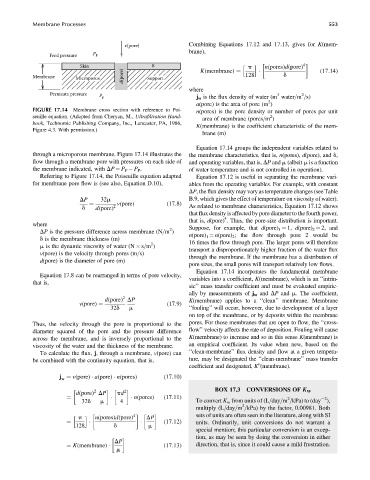
            FIGURE 17.14 Membrane cross section with reference to Poi-  n(pores) is the pore density or number of pores per unit
            seuille equation. (Adapted from Cheryan, M., Ultrafiltration Hand-             2
                                                                    area of membrane (pores=m )
            book, Technomic Publishing Company, Inc., Lancaster, PA, 1986,
                                                                  K(membrane) is the coefficient characteristic of the mem-
            Figure 4.3. With permission.)
                                                                    brane (m)
                                                                  Equation 17.14 groups the independent variables related to
            through a microporous membrane. Figure 17.14 illustrates the  the membrane characteristics, that is, n(pores), d(pore), and d,
            flow through a membrane pore with pressures on each side of  and operating variables, that is, DP and m (albeit m is a function
            the membrane indicated, with DP ¼ P F   P P .      of water temperature and is not controlled in operation).
              Referring to Figure 17.14, the Poiseuille equation adapted  Equation 17.12 is useful in separating the membrane vari-
            for membrane pore flow is (see also, Equation D.10),  ables from the operating variables. For example, with constant
                                                               DP,the flux density may vary as temperature changes (see Table
                           DP     32m                          B.9, which gives the effect of temperature on viscosity of water).
                                        v(pore)         (17:8)
                                      2
                            d   d(pore)                        As related to membrane characteristics, Equation 17.12 shows
                              ¼
                                                               that flux density is affected by pore diameter to the fourth power,
                                                                           4
                                                               that is, d(pore) . Thus, the pore-size distribution is important.
            where                                              Suppose, for example, that d(pore) 1 ¼ 1, d(pore) 2 ¼ 2, and
                                                         2
              DP is the pressure difference across membrane (N=m )
                                                               n(pore) 1 ¼ n(pore) 2 ;the flow through pore 2 would be
              d is the membrane thickness (m)                  16 times the flow through pore. The larger pores will therefore
                                                   2
              m is the dynamic viscosity of water (N   s=m )
                                                               transport a disproportionately higher fraction of the water flux
              v(pore) is the velocity through pores (m=s)
                                                               through the membrane. If the membrane has a distribution of
              d(pore) is the diameter of pore (m)
                                                               pore sizes, the small pores will transport relatively low flows.
                                                                  Equation 17.14 incorporates the fundamental membrane
              Equation 17.8 can be rearranged in terms of pore velocity,
                                                               variables into a coefficient, K(membrane), which is an ‘‘intrin-
            that is,
                                                               sic’’ mass transfer coefficient and must be evaluated empiric-
                                                               ally by measurements of j w and DP and m. The coefficient,
                                         2
                                    d(pore) DP                 K(membrane) applies to a ‘‘clean’’ membrane. Membrane
                                                        (17:9)
                                     32d    m                  ‘‘fouling’’ will occur, however, due to development of a layer
                           v(pore) ¼
                                                               on top of the membrane, or by deposits within the membrane
            Thus, the velocity through the pore is proportional to the  pores. For those membranes that are open to flow, the ‘‘cross-
            diameter squared of the pore and the pressure difference  flow’’ velocity affects the rate of deposition. Fouling will cause
            across the membrane, and is inversely proportional to the  K(membrane) to increase and so in this sense K(membrane) is
            viscosity of the water and the thickness of the membrane.  an empirical coefficient. Its value when new, based on the
              To calculate the flux, j, through a membrane, v(pore) can  ‘‘clean-membrane’’ flux density and flow at a given tempera-
            be combined with the continuity equation, that is,  ture, may be designated the ‘‘clean-membrane’’ mass transfer
                                                                                      o
                                                               coefficient and designated, K (membrane).
                     j ¼ v(pore)   a(pore)   n(pores)  (17:10)
                     w
                                2         2                             BOX 17.3  CONVERSIONS OF K W
                          d(pore) DP   pd
                                              n(pores)  (17:11)
                            32d   m      4                       To convert K w from units of (L=day=m =kPa) to (day ),
                       ¼                                                                        2           2
                                                                                 2
                                                                 multiply (L=day=m =kPa) by the factor, 0.00981. Both
                                             4                   sets of units are often seen in the literature, along with SI
                           p    n(pores)d(pore)  DP
                         h   i
                                                       (17:12)   units. Ordinarily, unit conversions do not warrant a
                          128         d           m
                       ¼
                                                                 special mention; this particular conversion is an excep-
                                                                 tion, as may be seen by doing the conversion in either

                                       DP
                                                       (17:13)   direction, that is, since it could cause a mild frustration.
                       ¼ K(membrane)
                                       m

