


Page 596 - Fundamentals of Water Treatment Unit Processes : Physical, Chemical, and Biological
P. 596
Membrane Processes                                                                               551


            quantitative rating in terms of size of particles rejected, for  The differences in transport models conceived by Sourir-
            example, MWCO for RO membranes.                    ajan (1970) and Reid and Breton (1959) during the deve-
              Membrane performance is judged primarily by two cri-  lopmental stages of membrane filtration later divided
            teria: (1) rejection fraction of intended solutes and (2) perme-  researchers into two groups: (1) those that believe water and
            ate flux density across the membrane and its rate of decline  solute transport across asymmetric membranes is due to
            due to fouling. These ‘‘dependent’’ variables are affected by a  advection=diffusion transport, and (2) those that believe in a
            number of ‘‘independent’’ variables, which include  solution–diffusion transport model. Baker (2000, p. 8)
                                                               stated that the latter, that is, the solution–diffusion model,
              1. Membrane pore size                            has been accepted since about 1980. The pores of an RO
              2. Membrane composition                          membrane are on the order of magnitude of 3–5 Å and
              3. Membrane configuration                         oscillate in size due to molecular vibration within the mem-
              4. Feed-water quality                            brane polymer. As a rule of thumb, the transition from the
              5. Changes in membrane properties due to induced  solution–diffusion model to the pore-flow model is in the
                 stresses                                      range of 5–10 Å (Baker, 2000, p. 19).
              6. Concentration polarization                       The Poiseuille equation (Equation D.11), used in fluid
              7. Operational parameters                        mechanics to describe laminar flow through pipes, is used
                                                               commonly to model advective transport through membrane
                                                               pores where the pressure differential on either side of the
            17.3.3 MODELS DESCRIBING WATER AND SOLUTE
                                                               membrane drives the transport (Weber, 1972; Duranceau
                    FLUX THROUGH MEMBRANES
                                                               et al., 1992; Amjad, 1993; Laisure et al., 1993). That water
            Several models have been proposed explaining the transfer of  flux is proportional to the Dp across the membrane, and is
            water and rejection of solutes by membranes. For micropor-  inversely proportional to viscosity, is well established by
            ous membranes, that is, MF and UF, most agree that water  experimental evidence. What is not clear is that since an RO
            moves across the membrane by advective transport and  membrane has a homogeneous molecular structure that does
            that the ‘‘rejected’’ suspended particles are physically  not show discernable ‘‘pores,’’ the laminar flow model does
            screened, that is, removed at the surface of the membrane  not seem plausible (in the sense that the pipe flow model may
            (Cheryan, 1986; AWWA, 1992). The permeate flow follows  be valid, which assumes zero velocity at the pipe wall and a
            the Poiseuille law, and is called the ‘‘pore-flow’’ model  parabolic velocity distribution).
            (Baker, 2000, p. 18).
              For the asymmetric membranes, that is, NF and RO, the
            explanation is not so clear. A number of models have been  17.3.4 BASIC NOTIONS FOR A CROSS-FLOW
            proposed such as: diffusion and advection, solution–diffusion,  MEMBRANE ELEMENT
            pore flow, frictional models based on irreversible thermo-
                                                               A ‘‘cross-flow’’ membrane is by definition one in which the
            dynamics, and empirical correlations (Pham et al., 1985).
                                                               ‘‘feed flow’’ between two membrane sheets passes through the
            Sourirajan (1970) in the late 1950s suggested a preferential
                                                               element and leaves it as ‘‘concentrate-flow.’’ The cross-flow
            sorption=capillary model where water was preferentially
                                                               is diminished by the permeate flow along the axis of the
            sorbed to the surface of the membrane while solutes experi-
                                                               membrane. Also, the cross-flow results in a shear along
            ence preferential repulsion. This behavior was dependent on
                                                               the membrane surface, which may erode some deposits.
            the both chemical nature of the membrane surface and the size
            of the pores. This sorption of water and repulsion of solutes
            resulted in the formation of a multimolecular layer of pure  17.3.4.1  Flow Balance
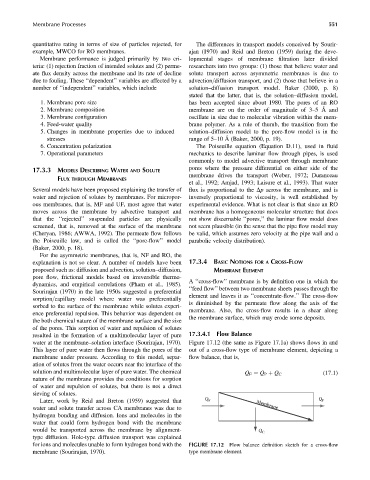
            water at the membrane–solution interface (Sourirajan, 1970).  Figure 17.12 (the same as Figure 17.1a) shows flows in and
            This layer of pure water then flows through the pores of the  out of a cross-flow type of membrane element, depicting a
            membrane under pressure. According to this model, separ-  flow balance, that is,
            ation of solutes from the water occurs near the interface of the
            solution and multimolecular layer of pure water. The chemical         Q F ¼ Q P þ Q C          (17:1)
            nature of the membrane provides the conditions for sorption
            of water and repulsion of solutes, but there is not a direct
            sieving of solutes.
              Later, work by Reid and Breton (1959) suggested that  Q F                                   Q P
            water and solute transfer across CA membranes was due to                 Membrane
            hydrogen bonding and diffusion. Ions and molecules in the
            water that could form hydrogen bond with the membrane
            would be transported across the membrane by alignment-                    Q C
            type diffusion. Hole-type diffusion transport was explained
            for ions and molecules unable to form hydrogen bond with the  FIGURE 17.12 Flow balance definition sketch for a cross-flow
            membrane (Sourirajan, 1970).                       type membrane element.

