


Page 788 - Fundamentals of Water Treatment Unit Processes : Physical, Chemical, and Biological
P. 788
Biological Reactors                                                                              743


                                                                   Gas collection


                                            Floating cover
                                                  Circulation
                            Multiple
                           sludge inlets
                                                                                  Gas collection

                                                                                  Multiple sludge outlets
                                                                                  Compressed gas
                                                Diffusers


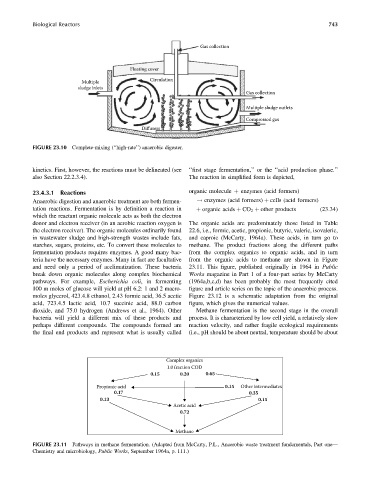
            FIGURE 23.10 Complete-mixing (‘‘high-rate’’) anaerobic digester.


            kinetics. First, however, the reactions must be delineated (see  ‘‘first stage fermentation,’’ or the ‘‘acid production phase.’’
            also Section 22.2.3.4).                            The reaction in simplified form is depicted,

            23.4.3.1  Reactions                                organic molecule þ enzymes (acid formers)
            Anaerobic digestion and anaerobic treatment are both fermen-  ! enzymes (acid formers) þ cells (acid formers)
            tation reactions. Fermentation is by definition a reaction in  þ organic acids þ CO 2 þ other products  (23:34)
            which the reactant organic molecule acts as both the electron
            donor and electron receiver (in an aerobic reaction oxygen is  The organic acids are predominately those listed in Table
            the electron receiver). The organic molecules ordinarily found  22.6, i.e., formic, acetic, propionic, butyric, valeric, isovaleric,
            in wastewater sludge and high-strength wastes include fats,  and caproic (McCarty, 1964a). These acids, in turn go to
            starches, sugars, proteins, etc. To convert these molecules to  methane. The product fractions along the different paths
            fermentation products requires enzymes. A good many bac-  from the complex organics to organic acids, and in turn
            teria have the necessary enzymes. Many in fact are facultative  from the organic acids to methane are shown in Figure
            and need only a period of acclimatization. These bacteria  23.11. This figure, published originally in 1964 in Public
            break down organic molecules along complex biochemical  Works magazine in Part 1 of a four-part series by McCarty
            pathways. For example, Escherichia coli, in fermenting  (1964a,b,c,d) has been probably the most frequently cited
            100 m moles of glucose will yield at pH 6.2: 1 and 2 macro-  figure and article series on the topic of the anaerobic process.
            moles glycerol, 423.4.8 ethanol, 2.43 formic acid, 36.5 acetic  Figure 23.12 is a schematic adaptation from the original
            acid, 723.4.5 lactic acid, 10.7 succinic acid, 88.0 carbon  figure, which gives the numerical values.
            dioxide, and 75.0 hydrogen (Andrews et al., 1964). Other  Methane fermentation is the second stage in the overall
            bacteria will yield a different mix of these products and  process. It is characterized by low cell yield, a relatively slow
            perhaps different compounds. The compounds formed are  reaction velocity, and rather fragile ecological requirements
            the final end products and represent what is usually called  (i.e., pH should be about neutral, temperature should be about


                                                        Complex organics
                                                        1.0 fraction COD
                                                   0.15     0.20     0.65

                                 Propionic acid                            0.15  Other intermediates
                                       0.17                                        0.35
                                  0.13                                                0.15
                                                          Acetic acid
                                                            0.72


                                                           Methane

            FIGURE 23.11  Pathways in methane fermentation. (Adapted from McCarty, P.L., Anaerobic waste treatment fundamentals, Part one—
            Chemistry and microbiology, Public Works, September 1964a, p. 111.)

