


Page 848 - Fundamentals of Water Treatment Unit Processes : Physical, Chemical, and Biological
P. 848
Appendix D: Fluid Mechanics—Reviews of Selected Topics 803
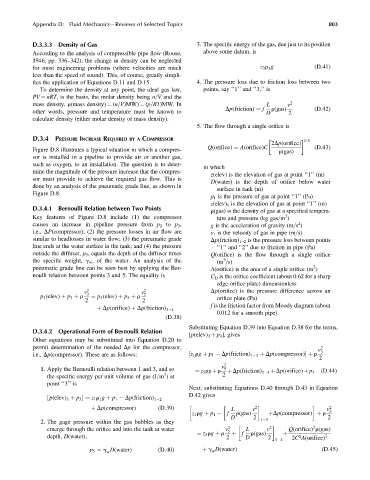
D.3.3.3 Density of Gas 3. The specific energy of the gas, due just to its position
According to the analysis of compressible pipe flow (Rouse, above some datum, is
1946, pp. 336–342), the change in density can be neglected
for most engineering problems (where velocities are much z 3 r g (D:41)
3
less than the speed of sound). This, of course, greatly simpli-
fies the application of Equations D.11 and D.15. 4. The pressure loss due to friction loss between two
To determine the density at any point, the ideal gas law, points, say ‘‘1’’ and ‘‘3,’’ is
PV ¼ nRT, is the basis, the molar density being n=V and the
mass density, r(mass density) ¼ (n=V)MW) ¼ (p=RT)MW. In L v 2
Dp(friction) ¼ f r(gas) (D:42)
other words, pressure and temperature must be known to D 2
calculate density (either molar density or mass density).
5. The flow through a single orifice is
D.3.4 PRESSURE INCREASE REQUIRED BY A COMPRESSOR 0:5
2Dp(orifice)
Q(orifice) ¼ A(orifice)C (D:43)
Figure D.8 illustrates a typical situation in which a compres- r(gas)
sor is installed in a pipeline to provide air or another gas,
such as oxygen, to an installation. The question is to deter-
in which
mine the magnitude of the pressure increase that the compres-
z(elev) is the elevation of gas at point ‘‘1’’ (m)
sor must provide to achieve the required gas flow. This is
D(water) is the depth of orifice below water
done by an analysis of the pneumatic grade line, as shown in
surface in tank (m)
Figure D.8.
p 1 is the pressure of gas at point ‘‘1’’ (Pa)
z(elev) 1 is the elevation of gas at point ‘‘1’’ (m)
D.3.4.1 Bernoulli Relation between Two Points
r(gas) is the density of gas at a specified tempera-
3
Key features of Figure D.8 include (1) the compressor ture and pressure (kg gas=m )
2
causes an increase in pipeline pressure from p 2 to p 3 , g is the acceleration of gravity (m=s )
i.e., DP(compressor); (2) the pressure losses in air flow are v 1 is the velocity of gas in pipe (m=s)
similar to headlosses in water flow; (3) the pneumatic grade Dp(friction) 1–2 is the pressure loss between points
line ends at the water surface in the tank; and (4) the pressure ‘‘1’’ and ‘‘2’’ due to friction in pipe (Pa)
outside the diffuser, p 5 , equals the depth of the diffuser times Q(orifice) is the flow through a single orifice
3
the specific weight, g w , of the water. An analysis of the (m =s)
2
pneumatic grade line can be seen best by applying the Ber- A(orifice) is the area of a single orifice (m )
noulli relation between points 3 and 5. The equality is C D is the orifice coefficient (about 0.62 for a sharp
edge orifice plate) dimensionless
v 2 3 v 2 5 Dp(orifice) is the pressure difference across an
p 3 (elev) þ p 3 þ r ¼ p 5 (elev) þ p 5 þ r orifice plate (Pa)
2 2
f is the friction factor from Moody diagram (about
þ Dp(orifice) þ Dp(friction) 3 4
0.012 for a smooth pipe)
(D:38)
Substituting Equation D.39 into Equation D.38 for the terms,
D.3.4.2 Operational Form of Bernoulli Relation
[p(elev) 3 þ p 3 ], gives
Other equations may be substituted into Equation D.20 to
permit determination of the needed Dp for the compressor, v 2
i.e., Dp(compressor). These are as follows: ½ z 1 rg þ p 1 Dp(friction) 1 3 þ Dp(compressor) þ r 3
2
v 2
1. Apply the Bernoulli relation between 1 and 3, and so ¼ z 5 rgþr 5 þDp(friction) 3 4 þDp(orifice)þp 5 (D:44)
3
the specific energy per unit volume of gas (J=m )at 2
point ‘‘3’’ is
Next, substituting Equations D.40 through D.43 in Equation
D.42 gives
p(elev) 3 þ p 3 ¼ z 1 r g þ p 1 Dp(friction) 1 2
½ 1
þ Dp(compressor) (D:39) L v 2 v 2
z 1 rg þ p 1 f r(gas) þDp(compressor) þ r 3
D 2 1 3 2
2. The gage pressure within the gas bubbles as they
2
emerge through the orifice and into the tank at water v 2 5 L v 2 Q(orifice) r(gas)
¼ z 5 rg þ r þ f r(gas)
depth, D(water), 2 D 2 þ 2C A(orifice) 2
2
3 4
p 5 ¼ g D(water) (D:40) þ g D(water) (D:45)
w
w

