


Page 868 - Fundamentals of Water Treatment Unit Processes : Physical, Chemical, and Biological
P. 868
Appendix E:  Porous Media Hydraulics                                                             823


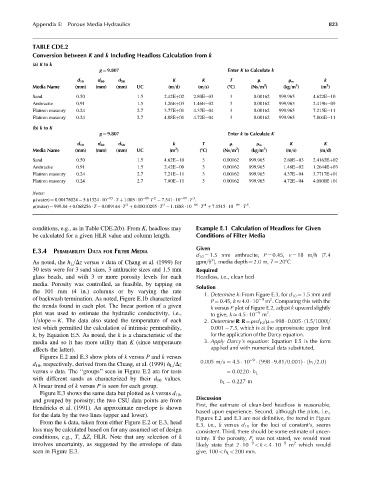
            TABLE CDE.2
            Conversion between K and k Including Headloss Calculation from k
            (a) K to k
                                  g ¼ 9.807                                 Enter K to Calculate k
                                                          K         K        T                              k
                          d 10   d 60   d 50                                          m         r w
                                                                                                  3
                                                                                                            2
                                                                                        2
            Media Name    (mm)  (mm)   (mm)   UC        (m=d)     (m=s)     (8C)    (Ns=m )   (kg=m )      (m )
            Sand          0.50                1.5      2.42Eþ02  2.80E 03    3       0.00162  999.965   4.622E 10
            Anthracite    0.91                1.5      1.26Eþ03  1.46E 02    3       0.00162  999.965   2.419E 09
            Flatiron masonry  0.24            2.7      3.77Eþ01  4.37E 04    3       0.00162  999.965   7.215E 11
            Flatiron masonry  0.24            2.7      4.08Eþ01  4.72E 04    3       0.00162  999.965   7.804E 11
            (b) k to K
                                  g ¼ 9.807                                 Enter k to Calculate K

                          d 10   d 60   d 50              k         T        m       r w        K           K
                                                                               2
                                                                                        3
                                                           2
            Media Name    (mm)  (mm)   (mm)   UC         (m )      (8C)   (Ns=m )   (kg=m )    (m=s)      (m=d)
            Sand          0.50                1.5      4.62E 10     3      0.00162  999.965   2.80E 03  2.4162Eþ02
            Anthracite    0.91                1.5      2.42E 09     3      0.00162  999.965   1.46E 02  1.2644Eþ03
            Flatiron masonry  0.24            2.7      7.21E 11     3      0.00162  999.965   4.37E 04  3.7717Eþ01
            Flatiron masonry  0.24            2.7      7.80E 11     3      0.00162  999.965   4.72E 04  4.0800Eþ01
            Notes:
                                                    2
                                                                 3
            m(water) ¼ 0.00178024   5.61324   10   05   T þ 1.003   10  06  T   7.541   10  09    T .
                                                                    4
                                                                                  5
                                           2
                                                       3
            r(water) ¼ 999.84 þ 0.068256   T – 0.009144   T þ 0.00010295   T – 1.1888   10  06   T þ 7.1515   10  09    T .
            conditions, e.g., as in Table CDE.2(b). From K, headloss may  Example E.1 Calculation of Headloss for Given
            be calculated for a given HLR value and column length.  Conditions of Filter Media
                                                                  Given
            E.3.4 PERMEABILITY DATA FOR FILTER MEDIA
                                                                  d 10 ¼ 1.5 mm anthracite, P ¼ 0.45, v ¼ 18 m=h (7.4
                                                                       2
            As noted, the h L =Dz versus v data of Chang et al. (1999) for  gpm=ft ), media depth ¼ 2.0 m, T ¼ 208C
            30 tests were for 3 sand sizes, 3 anthracite sizes and 1.5 mm  Required
            glass beads, and with 3 or more porosity levels for each  Headloss, i.e., clean bed
            media. Porosity was controlled, as feasible, by tapping on
                                                                  Solution
            the 101 mm (4 in.) columns or by varying the rate
                                                                    1. Determine k: From Figure E.3, for d 10 ¼ 1.5 mm and
            of backwash termination. As noted, Figure E.1b characterized               9  2
                                                                      P ¼ 0.45, k   4.0   10  m . Comparing this with the
            the trends found in each plot. The linear portion of a given  k versus P plot of Figure E.2, adjust k upward slightly
            plot was used to estimate the hydraulic conductivity, i.e.,  to give, k   4.5   10  9  m .
                                                                                         2
            1=slope ¼ K. The data also stated the temperature of each  2. Determine R: R ¼ rvd 10 =m ¼ 998   0.005  (1.5=1000)=
            test which permitted the calculation of intrinsic permeability,  0.001¼ 7.5, which is at the approximate upper limit
            k, by Equation E.5. As noted, the k is a characteristic of the  for the application of the Darcy equation.
            media and so it has more utility than K (since temperature  3. Apply Darcy’s equation: Equation E.5 is the form
            affects the latter).                                      applied and with numerical data substituted,
              Figures E.2 and E.3 show plots of k versus P and k versus
                                                                   0:005 m=s ¼ 4:5   10  9
            d 10 , respectively, derived from the Chang, et al. (1999) h L =Dz         998   9:81=0:001Þ   h L =2:0Þ
                                                                                      ð
                                                                                                      ð
            versus v data. The ‘‘groups’’ seen in Figure E.2 are for tests  ¼ 0:0220   h L
            with different sands as characterized by their d 10 values.
                                                                         h L ¼ 0:227 m
            A linear trend of k versus P is seen for each group.
              Figure E.3 shows the same data but plotted as k versus d 10 ,
                                                                  Discussion
            and grouped by porosity; the two CSU data points are from
                                                                  First, the estimate of clean-bed headloss is reasonable,
            Hendricks et al. (1991). An approximate envelope is shown
                                                                  based upon experience. Second, although the plots, i.e.,
            for the data by the two lines (upper and lower).
                                                                  Figures E.2 and E.3 are not definitive, the trend in Figure
              From the k data, taken from either Figure E.2 or E.3, head
                                                                  E.3, i.e., k versus d 10 for the loci of constant’s, seems
            loss may be calculated based on for any assumed set of design  consistent. Third, there should be some estimate of uncer-
            conditions, e.g., T, DZ, HLR. Note that any selection of k  tainty. If the porosity, P, was not stated, we would most
                                                                                                  2
            involves uncertainty, as suggested by the envelope of data  likely state that 2   10  9 < k < 4   10  9  m which would
            seen in Figure E.3.                                   give, 100 < h L < 200 mm.

