


Page 870 - Fundamentals of Water Treatment Unit Processes : Physical, Chemical, and Biological
P. 870
Appendix E:  Porous Media Hydraulics                                                             825


                             10 –8

                                                                        CSU
                             10 –9                                     Filter media
                                                                  CSU
                                                                        Natural media
                             10 –10
                                                        Empire SS
                            k (m 2 )                    Max

                             10 –11
                                                                 Min


                             10 –12                                            Very coarse sand
                                          Clay and  slit  Very fine  sand  Fine sand  Medium sand  Coarse sand  Gravel


                             10 –13
                                0.01                  0.1                   1                    10
                                                              d  (mm)
                                                               50
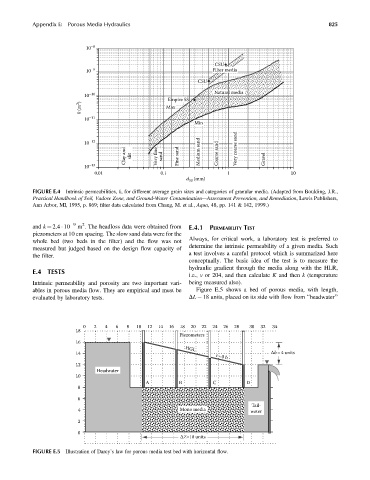
            FIGURE E.4 Intrinsic permeabilities, k, for different average grain sizes and categories of granular media. (Adapted from Boulding, J.R.,
            Practical Handbook of Soil, Vadose Zone, and Ground-Water Contamination—Assessment Prevention, and Remediation, Lewis Publishers,
            Ann Arbor, MI, 1995, p. 869; filter data calculated from Chang, M. et al., Aqua, 48, pp. 141 & 142, 1999.)


                         9  2
            and k ¼ 2.4   10  m . The headloss data were obtained from  E.4.1 PERMEABILITY TEST
            piezometers at 10 cm spacing. The slow sand data were for the
                                                               Always, for critical work, a laboratory test is preferred to
            whole bed (two beds in the filter) and the flow was not
                                                               determine the intrinsic permeability of a given media. Such
            measured but judged based on the design flow capacity of
            the filter.                                         a test involves a careful protocol which is summarized here
                                                               conceptually. The basic idea of the test is to measure the
                                                               hydraulic gradient through the media along with the HLR,
            E.4 TESTS
                                                               i.e., v or 204, and then calculate K and then k (temperature
            Intrinsic permeability and porosity are two important vari-  being measured also).
            ables in porous media flow. They are empirical and must be  Figure E.5 shows a bed of porous media, with length,
            evaluated by laboratory tests.                     DL ¼ 18 units, placed on its side with flow from ‘‘headwater’’


                            0   2   4  6   8  10  12  14  16  18  20  22  24  26  28  30  32  34
                          18
                                                            Piezometers
                          16
                                                              HGL
                          14                                                              Δh=4 units
                                                                        t=0 h
                          12
                                 Headwater
                          10
                                                 A          B          C          D
                           8

                           6
                                                                                    Tail-
                           4                                Mono media             water
                           2
                           0
                                                            ΔZ=18 units

            FIGURE E.5 Illustration of Darcy’s law for porous media test bed with horizontal flow.

