


Page 295 - Gas Purification 5E
P. 295
Removal and Use of Ammonia in Gas Purification   279

                                            INTRODUCTION

                   In previous editions of this book the removal of ammonia from gas streams and the use of
                 ammonia to remove H2S and C02 were covered in separate chapters. The two subjects have
                 been combined into a single chapter in this edition because (1) the technologies are closely
                 interrelated, (2) the use of aqueous ammonia to absorb H2S and C02 is declining relative to
                 other, more efficient processes, and (3) the subjects are of most interest with regard to coal
                 gas purification, which is not currently an expanding field.
                 Types of Coal Gas

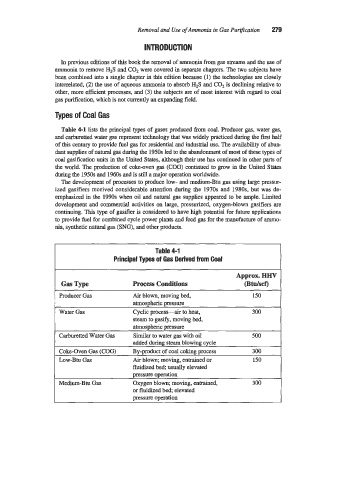
                   Table 4-1 lists the principal types of  gases produced from coal. Producer gas, water gas,
                 and carburetted water gas represent technology that was widely practiced during the first half
                 of this century to provide fuel gas for residential and industrial use. The availability of abun-
                 dant supplies of natural gas during the 1950s led to the abandonment of most of these types of
                 coal gasification units in the United States, although their use has continued in other parts of
                 the world. The production of coke-oven gas (COG) contkued to grow in the United States
                 during the 1950s and 1960s and is still a major operation worldwide.
                   The development of processes to produce low- and medium-Btu gas using large pressur-
                 ized gasifiers received considerable attention during the  1970s and  1980s, but was de-
                 emphasized in the  1990s when oil and natural gas supplies appeared to be ample. Limited
                 development and commercial activities on large, pressurized, oxygen-blown gasifiers are
                 continuing. This type of gasifier is considered to have high potential for future applications
                 to provide fuel for combined cycle power plants and feed gas for the manufacture of ammo-
                 nia, synthetic natural gas (SNG), and other products.


                                               Table 4-1
                                   Principal Types of Gas Derived from Coal

                                                                       Approx. HHV
                   Gas Type              Process Conditions               (Btdscf)
                   Producer Gas          Air blown, moving bed,             150
                                         atmospheric pressure
                   Water Gas             Cyclic process-air to heat,        300
                                         steam to gasify, moving bed,
                                         atmospheric pressure
                   Carburetted Water Gas   Similar to water gas with oil    500
                                         added during steam blowing cycle
                   Coke-Oven Gas (COG)   By-product of coal coking process   300
                   Low-Btu Gas           Air blown; moving, entrained or    150
                                         fluidized bed; usually elevated
                                         DRSSU~~ oueration
                   Medim-Btu Gas         Oxygen blown; moving, entrained,   300
                                         or fluidized bed; elevated
                                         pressure operation

