


Page 298 - Gas Purification 5E
P. 298
282   Gas Purification

                    before the advent of synthetic ammonia, when coal gas constituted the largest source of fmed
                    nitrogen.
                     Carbon dioxide is also a major impurity in coal gas. Although it is not generally necessary
                    to remove COP from gases used as fuels, partial removal is sometimes desirable to improve
                    the heating value. Complete C02 elimination is required for gases undergoing processing at
                    very low temperatures, for example, in cokeoven gas purification to provide hydrogen for
                    ammonia synthesis. The removal of other impurities such as HCN, COS, organic acids, and
                    pyridine may also be required when the concentration is high enough to cause pollution or
                    operating problems in downstream systems.
                     As indicated by the data of Table 4-4, gases produced by oxygen-blown gasifiers general-
                    ly contain appreciably less ammonia than coke oven gas. As  a result, the use of  aqueous
                    ammonia has not been developed as a gas purification technique for such gases. Gases pro-
                    duced by air-blown gasifiers and by the thermal treatment of petroleum streams (including
                    shale oil and tar sands liquids) are also relatively low in ammonia and are not considered to
                    be appropriate candidates for ammonia-based scrubbing processes.

                    Sources of Sour Water

                      In refinery catalytic cracking operations, oxygen-blown coal gasifiers and similar high
                    temperature processes that produce a gas stream containing both ammonia and hydrogen sul-
                    fide, the gas leaving the high temperature step is typically quenched with water or cooled by
                    indirect heat exchange and then scrubbed with water. The resulting “sour water” contains
                    essentially all of the ammonia, but normally contains only a small portion of  the H2S and
                    C02 contained in the gas stream. It also contains water soluble impurities such as organic
                    acids and phenols. Considerable development work has gone into the processing of  sour
                    water. Because its processing constitutes an essential step in the overall gas purification
                    scheme, and ammonia is always one component, key processes for sour water treatment are
                    described in the Ammonia Removal section of this chapter.


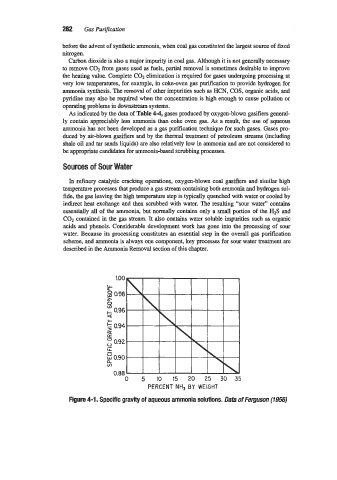
                                             PERCENT NH,  BY  WEIGHT
                      Figure 4-1. Specific gravity of aqueous ammonia solutions. Data of Fernuson (795s)

