


Page 297 - Gas Purification 5E
P. 297
Removal and Use of Ammonia in Gas Purijication   281

                 Coal Gas Impurities

                   Ammonia, hydrogen sulfide, and carbon dioxide are major impurities in coke oven gas
                 (COG). In addition to these three components, COG often contains carbon disulfide, carbonyl
                 sulfide, hydrogen cyanide, organic acids, pyridine, phenol, and other impurities, which can
                 cause problems with conventional amine plants. The presence of large quantities of ammonia in
                 these gases naturally led to consideration of its use for removal of H2S and COz, and several
                 ammonia-based coke oven gas purification processes have been developed and commercialid.
                   Processes that use aqueous ammonia to remove HzS  and COz are still offered for coke-
                 oven gas purification, and many such plants are in operation in the U.S. and Europe; howev-
                 er, it appears that the trend for new operations is toward the use of  other absorbents. Other
                 absorption processes that may be applicable for COG purification include the Takahax,
                 Stretford, Vacuum Carbonate, Potassium Carbonate, and Sulfiban (MEA) processes. These
                 processes can be designed to avoid serious adverse effects of trace impurities in the gas, and
                 generally provide somewhat higher H2S removal efficiency than ammonia scrubbing. The
                 processes are described in detail in other chapters (see index).
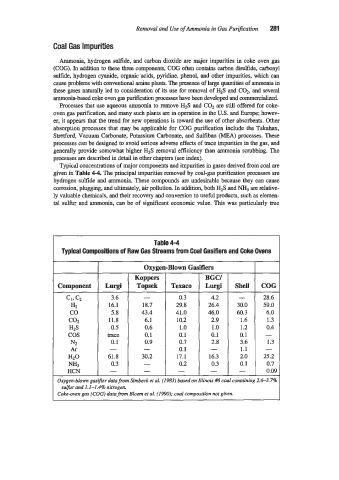
                   Typical concentrations  of major components and impurities in gases derived from coal are
                 given in Table 4-4.  The principal impurities removed by coal-gas purification processes are
                 hydrogen sulfide and ammonia. These compounds are undesirable because they can cause
                 corrosion, plugging, and ultimately, air pollution. In addition, both H2S and NH3 are relative-
                 ly valuable chemicals, and their recovery and conversion to useful products, such as elemen-
                 tal sulfur and ammonia, can be of  significant economic value. This was particularly true


                                               Table 4-4
                   Typical Compositions of Raw Gas Streams from Coal Gasifiers and Coke Ovens


                                         Koppers              BGCI
                  Component     Lurgi     Topsek    Texaco    Lurgi    Shell   COG
                     CI, cz       3.6       -         0.3       4.2     -      28.6
                      HZ         16.1      18.7      29.8      26.4    30.0    59.0
                      co          5.8      43.4      41.0      46.0    60.3     6.0
                     COZ         11.8       6.1       10.2      2.9     1.6     1.3
                      HZS         0.5       0.6       1 .o      1 .o    1.2     0.4
                     cos         trace      0.1       0.1       0.1     0.1     -
                      N2          0.1       0.9       0.7       2.8     3.6     1.3
                      Ar          -         -         0.1       -       1.1     -
                     HZO         61.8      30.2       17.1     16.3     2.0    25.2
                     NH3          0.3       -         0.2       0.3     0.1     0.7
                     HCN          -         -         -         -       -       0.09
                  Oxygen-blown gasij?er datafrom Simbeck et al. (1983) based on Illinois #6 coal containing 2.6-3.7%
                   sulfur and 1.1-1.496 nitrogen
                  Coke-oven gas (COG) data from Bloem et al. (1990); coal composition not given.

