


Page 296 - Gas Purification 5E
P. 296
280    Gas Punflcation

                   Sources of Ammonia

                     During the gasification, carbonization, and thermal treatment of  coal, liquid petroleum,
                   shale oil, and tar sands products, a portion of the nitrogenous material contained in the feed
                   is converted to volatile compounds that appear in the gaseous products. The principal nitro-
                   gen compounds that have been identified in such gases are ammonia, cyanogen, hydrogen
                   cyanide, pyridine and its homologues, nitric oxide, and free nitrogen. Although the nitrogen
                   present in the fuel is the primary source of these compounds, small amounts of atmospheric
                   nitrogen may also contribute  to the presence of nitrogen compounds in the gas stream.
                     The distribution and concentration of nitrogen compounds in the gaseous products for a
                   given fuel vary over a wide range depending on operating conditions of the gasifier, reactor,
                   or coke oven. The principal operating variables influencing the distribution of nitrogen com-
                   pounds are temperature, time at temperature, and quantity of steam or oxygen used. For coal
                   carbonization, temperature has the most pronounced effect. For example, the fraction of the
                   nitrogen contained in coal that is converted to ammonia varies from about 2% at a carboniza-
                   tion temperature of  400°C (750°F), which is typical for low-temperature carbonization
                   processes,  to 10-15% at 900°C (1,650"F) or higher, the range of typical high temperature
                   carbonization installations.
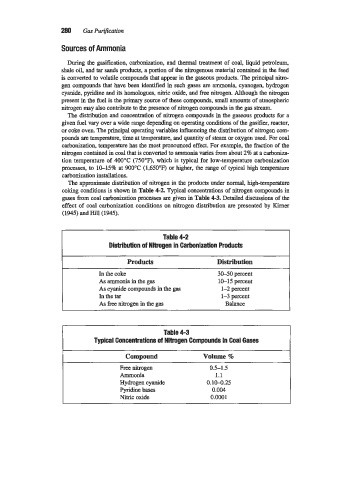
                     The approximate distribution of nitrogen in the products under normal, high-temperature
                   coking conditions is shown in Table 4-2. Typical concentrations of nitrogen compounds in
                   gases from coal carbonization processes are given in Table 4-3. Detailed discussions of the
                   effect of  coal carbonization conditions on nitrogen distribution are presented by  Kirner
                   (1945) and Hill (1945).


                                                 Table 4-2
                                 Distribution of Nitrogen in Carbonization Products


                                       Products                  Distribution
                              In the coke                        30-50 percent
                              As ammonia in the gas               10-15 percent
                              As cyanide compounds in the gas      1-2 percent
                              In the tar                           1-3 percent
                              As free nitrogen in the gas           Balance


                                                 Table 4-3
                             Typical Concentrations of Nitrogen Compounds in Coal Gases

                                      Compound               Volume %
                                     Free nitrogen             0.5-1.5
                                     Ammonia                     1.1
                                     Hydrogen cyanide         0.10-0.25
                                     Pyridine bases             0.004
                                     Nitric oxide              0.0001

