


Page 301 - Gas Purification 5E
P. 301
Removal and Use of Ammonia in Gas Purification   285

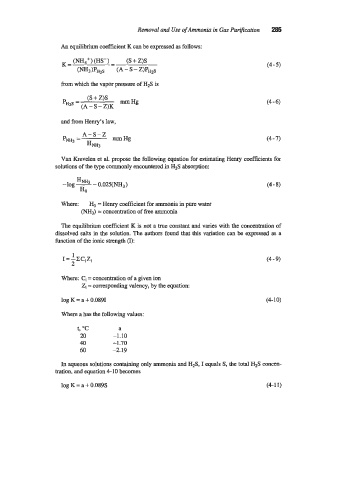
                   An equilibrium coefficient K can be expressed as follows:


                   from which the vapor pressure of H2S is

                           (S + Z)S
                                                                                  -
                    pHzS  =             Hg                                      (4 6)
                         (A - S- Z)K
                   and from Henry's law,


                   Van Krevelen et al. propose the following equation for estimating Henry coefficients for
                  solutions of the type commonly encountered  in H2S absorption:

                        HNH3
                    -log - -  O.O25(NH,)                                        (4-8)
                         HO
                   Where:   H,,  = Henry coefficient for ammonia in pure water
                         (NH3) = concentration of free ammonia

                   The equilibrium coefficient K is not a true constant and varies with the concentration of
                  dissolved salts in the solution. The authors found that this variation can be  expressed as a
                  function of the ionic strength (I):

                       1
                    I = --zcizj                                                 (4 9)
                                                                                  -
                      2
                   Where: Ci = concentration of a given ion
                         Z, = corresponding valency, by the equation:

                   log K = a + 0.0891                                           (4- 10)

                   Where a has the following values:
                        t, "C       a
                         20        -1.10
                         40        -1.70
                         60        -2.19

                   In aqueous solutions containing only ammonia and H2S, I equals S, the total H2S concen-
                  tration, and equation 4-10 becomes

                   log K = a + 0.089s                                           (4-1 1)

